

 Client details, platform screens, and raw operational data have been anonymized or reconstructed in representative form due to NDA and white-label confidentiality requirements. The workflow logic, optimization decisions, and performance direction shown here reflect the actual engagement.
Higher Webinar Show-Up Rate
More Qualified Applications
Lower Cost per Attended Webinar
Confidential Premium EdTech Brand sells a webinar-led, counselor-assisted upskilling program in a competitive category. In this model, registration volume is not the real KPI. The business grows only when registered users actually attend live, stay engaged, move into qualified applications, and ultimately convert into efficient enrollments.
On the surface, the Meta account looked active. Registrations were coming in, spend was moving, and dashboard activity did not immediately suggest a breakdown. But beneath that, too much of the acquired demand was commercially weak. Too many users were registering out of curiosity rather than commitment, and too little of that activity was progressing into strong application intent.
This is the kind of problem that creates an acquisition illusion: the ad account appears productive while the system beneath it leaks value.
The issue was not that Meta could not generate interest. The issue was that the acquisition system was optimized too high in the funnel.
When Meta is rewarded mainly for easy registrations, it finds more people willing to fill out forms. That does not automatically mean it finds more people ready to attend a serious webinar, submit a qualified application, or move toward a premium counselor-assisted offer. Funnel review pointed to four commercial bottlenecks:
From a revenue leader’s perspective, this was not a media-buying problem alone. It was a system-level efficiency problem.
A full-funnel review showed that leakage was happening across multiple stages, not just inside the ad account.
| Stage | Diagnosed Flaw | Commercial Impact |
|---|---|---|
| Ad Promise | Messaging attracted curiosity, but not all of that curiosity represented serious buyer intent. | Higher registration volume from lower-readiness users. |
| Registration Form | The form was too frictionless for a premium offer and did too little to separate casual interest from serious consideration. | Weak filtering and poor demand quality entering the funnel. |
| Confirmation Experience | The post-submit experience did not build enough commitment, clarity, or urgency around attending live. | Reduced seriousness after sign-up. |
| Reminder Journey | Reminder logic lacked enough expectation-setting, proof reinforcement, and timing discipline. | Intent decay before the webinar. |
| Webinar-to-Application Transition | The path from live attendance to application was not structured tightly enough. | Lost momentum and weaker next-step conversion. |
The root issue was misalignment. Ad promise, qualification logic, signal architecture, reminder continuity, and next-step conversion were not functioning as one integrated acquisition system.
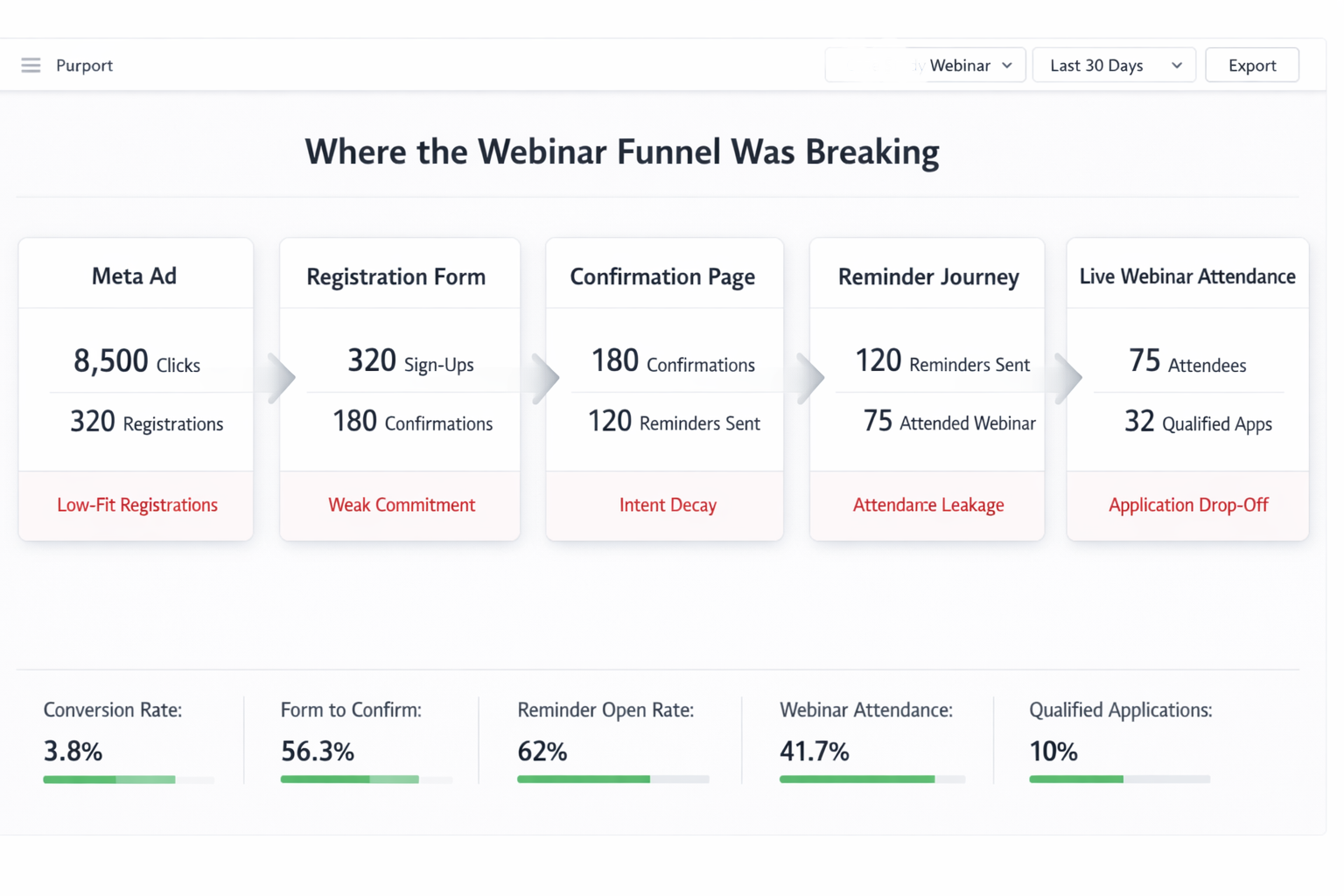
The acquisition system was rebuilt around stronger qualification, deeper signal feedback, tighter reminder continuity, and cleaner webinar-to-application alignment.
The structural change can be read through four proof lenses: qualification quality, signal quality, intent preservation, and conversion continuity.
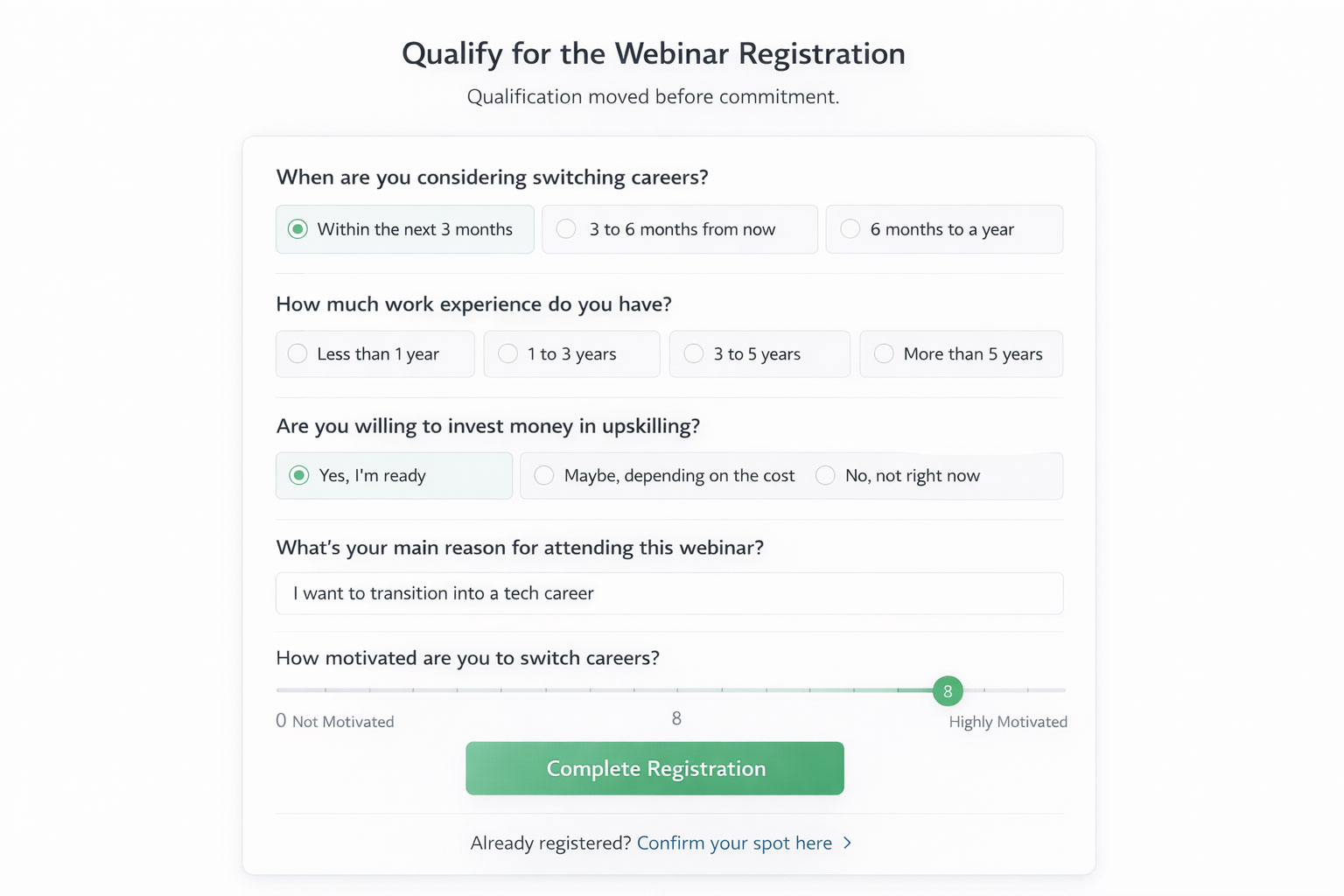
The revised registration flow introduced selective friction to distinguish casual curiosity from genuine program consideration.
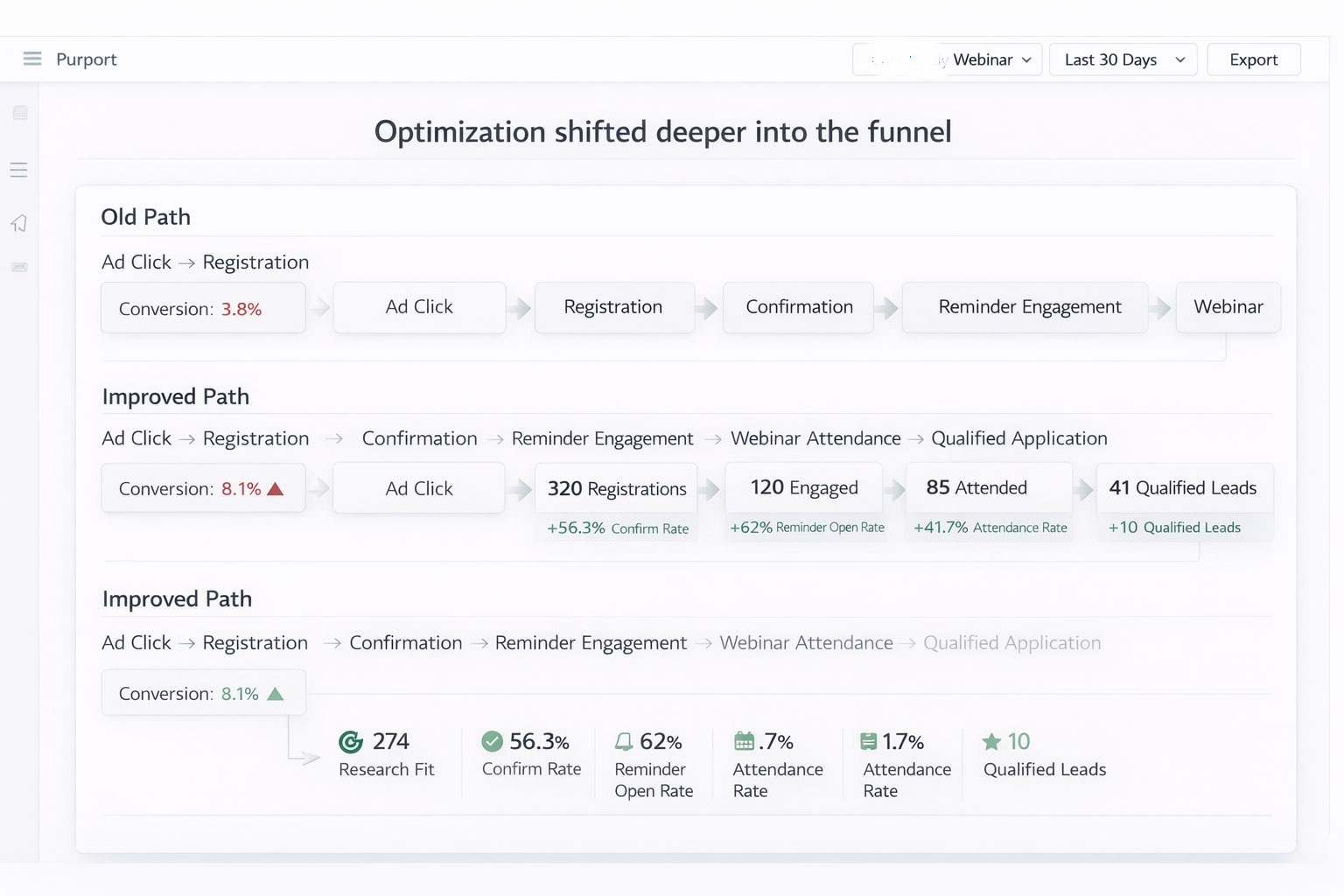
Signal depth improved by moving optimization closer to attendance quality and application progression.
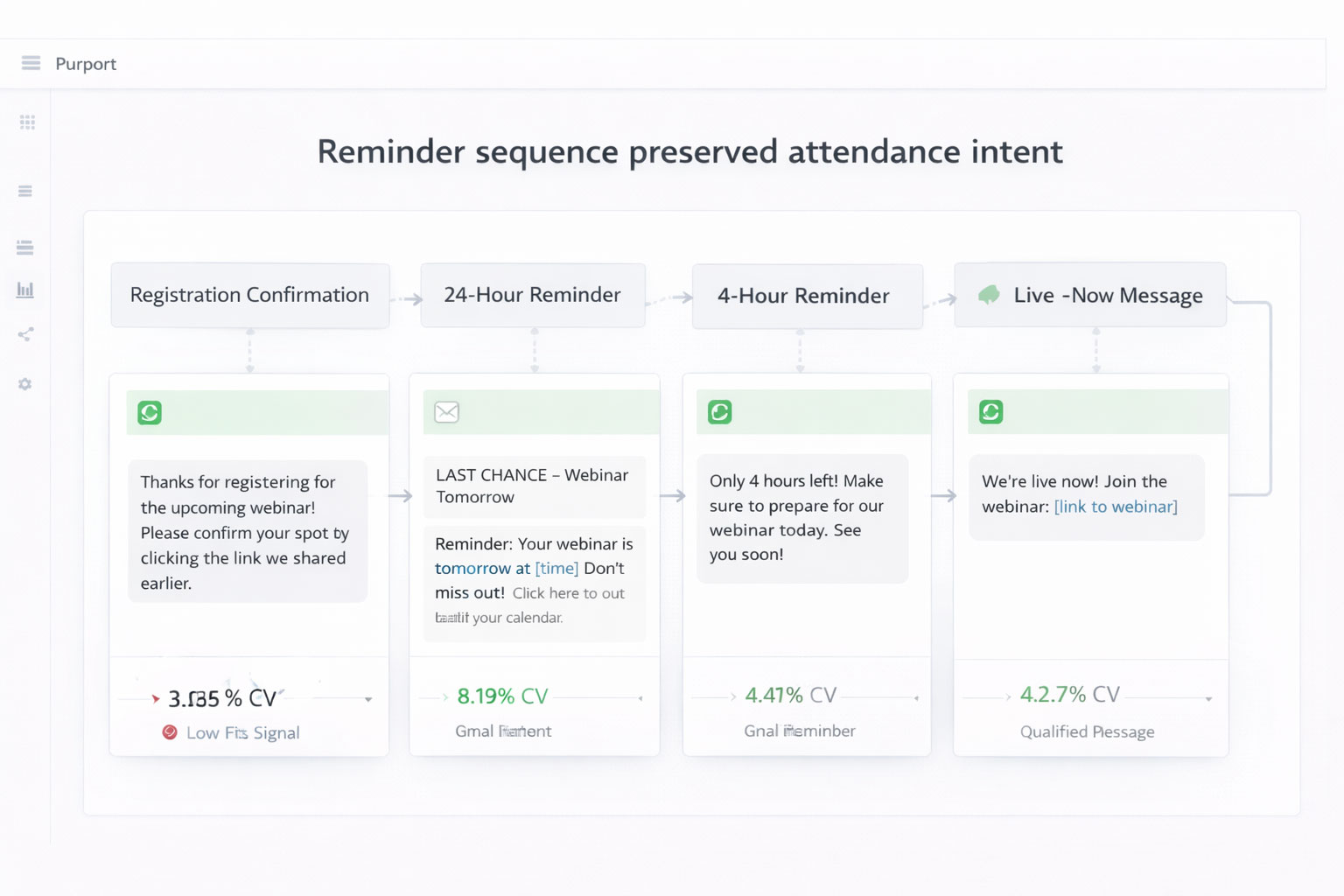
Expectation-setting, reminders, and proof reinforcement reduced intent decay before the live webinar.
The solution was not to simply improve ads. The account had to be restructured from a loose registration model into an intent-based webinar acquisition system.
The first priority was improving the quality of feedback Meta received. Instead of optimizing purely for easy registrations, the strategy moved closer to actions tied to attendance quality and application intent.
The funnel introduced stronger qualification so the system could absorb more serious demand and reject weak-fit volume before operational effort was consumed.
Creative, targeting, and messaging were refined to attract users with stronger fit, higher seriousness, and more relevant intent instead of broad curiosity traffic.
A stronger reminder and nurture layer was introduced between sign-up and attendance. This protected intent by reinforcing timing, benefits, seriousness, and next-step expectations before the webinar.
The webinar and application path were reframed to make the transition more natural, more credible, and more commercially useful.
Within the first 24-day impact window, the funnel improved across the three commercial metrics that mattered most.
| Metric | Before | After | Change | Commercial Meaning |
|---|---|---|---|---|
| Webinar Show-Up Rate | 24% | 35% | 46% Higher | A materially larger share of registrations became live attendees. |
| Qualified Applications | 11 | 23 | 2.1X More | More commercially useful opportunities entered the admissions pipeline. |
| Cost per Attended Webinar | ₹2,420 | ₹1,597 | 34% Lower | Spend translated into real participation more efficiently. |
These outcomes matter because attendance quality, qualified opportunity flow, and acquisition efficiency improved together. That pattern is more consistent with a healthier acquisition system, not just a cheaper one.
These results should be read as a measured 24-day performance window, not as a permanent lifetime average.
The improvement was visible not just in reporting, but in how the admissions process functioned day to day. Because more users arrived with stronger alignment and better intent, the team spent less time re-educating low-readiness prospects and more time having meaningful decision-stage conversations.
That improved counselor productivity, reduced wasted effort, and increased the value of existing team capacity without requiring equivalent headcount expansion.
It would be irresponsible to claim perfect mathematical causality from a short performance window. But the observed pattern was directionally consistent with the changes introduced during the intervention period:
For a premium EdTech offer, cost per attended webinar and qualified application quality are more meaningful than raw registration count alone. A lower cost per attended webinar creates more room inside the business’s allowable acquisition thresholds while stronger application quality improves the efficiency of downstream human effort.
This is what profitable acquisition discipline looks like: better intent, better throughput, and better economics moving together.
The gain did not come from inventing a new business model. It came from improving how the acquisition system worked.
This was a measured performance story, not a claim of universal certainty. The strength of the case lies in the alignment of the outcome metrics: higher webinar attendance quality, more qualified applications, and lower cost per attended webinar.
The most commercially credible conclusion is simple: the client did not just improve ads. It improved the acquisition system.
This case highlights a common EdTech mistake: confusing registration volume with acquisition health. When Meta is optimized for easy conversions rather than meaningful ones, the business often ends up buying operational friction instead of scalable demand.
By rebuilding the funnel around stronger qualification, better signal depth, tighter reminder continuity, and more coherent webinar-to-application flow, the client improved the metrics that serious founders and growth leaders actually care about: attendance quality, qualified opportunity flow, and efficient acquisition economics.
That is what profitable scaling discipline looks like in Meta-led EdTech growth.
The commercial impact was visible not only in performance metrics but also in how the admissions pipeline functioned day to day.

“We were generating registrations, but too many of them never became meaningful opportunities. What changed here was not just volume — it was intent. More of the people entering the webinar journey were serious, better informed, and far more likely to move forward.”
Confidentiality Note:
This engagement was delivered under white-label and NDA constraints. To protect client confidentiality, identifying details, platform screens, and raw data have been anonymized or reconstructed in representative form. The workflow logic, structural changes, and performance direction shown here reflect the real engagement.
UXGen Technologies, U211, Vaishnav Enclave, Sec. 67A, Dhumaspur Rd, Gurugram, HR 122101
Book a free 30-minute EdTech Funnel Audit. We will review your offer, landing page, lead qualification flow, tracking logic, and counseling journey to identify where intent is breaking, where quality is leaking, and what needs to be fixed first.

