

 Client details, platform screens, and raw operational data have been anonymized or reconstructed in representative form due to NDA and white-label confidentiality requirements. The workflow logic, optimization decisions, and performance direction shown here reflect the actual engagement.
Lower Cost per Enrollment
More Qualified Counseling Calls
Higher Lead-to-Enrollment Efficiency
Confidential EdTech Brand sells a premium, counselor-assisted data analytics program for career switchers. In this category, lead volume is not the real KPI. The business grows only when leads become qualified counseling conversations and, ultimately, paid enrollments at an efficient cost.
On the surface, the Meta account looked active. Leads were coming in, spend was moving, and dashboard activity did not immediately suggest a breakdown. But beneath that, too many leads were low-intent. Counselors were spending time on prospects who were curious but not ready, and too little of that activity was progressing into meaningful enrollment outcomes.
This is the kind of problem that creates an acquisition illusion: the ad account appears productive while the system beneath it leaks value.
The issue was not that Meta could not generate interest. The issue was that the acquisition system was optimized too high in the funnel.
When Meta is rewarded primarily for cheap lead submissions, it finds more people willing to submit forms. That does not automatically mean it finds more people ready to invest in a serious career-upskilling program. Funnel review pointed to four commercial bottlenecks:
From a revenue leader’s perspective, this was not a media-buying problem alone. It was a system-level efficiency problem.
A full-funnel review showed that leakage was happening across multiple stages, not just inside the ad account.
| Stage | Diagnosed Flaw | Commercial Impact |
|---|---|---|
| Lead Capture | Forms were too frictionless and too weakly qualifying for a premium counselor-assisted offer. | High lead volume, weak lead quality, and unnecessary sales-floor drag. |
| Signal Feedback | Optimization signals were stopping too early in the journey. | Meta was being rewarded for easier submissions instead of enrollment-relevant movement. |
| Messaging | Ads were attracting curiosity, but not all of that curiosity was commercial intent. | More clicks and leads from low-readiness users. |
| Post-Booking | Minimal pre-call nurturing meant intent could decay between booking and attendance. | More no-shows, weaker call preparedness, and lower conversion potential. |
| Landing Page | The page was not doing enough to clarify fit, seriousness, and next-step expectations. | Trust loss, weaker qualification, and lower downstream conversion quality. |
The root issue was misalignment. Ad messaging, qualification logic, signal architecture, and sales readiness were not working together as one acquisition system.
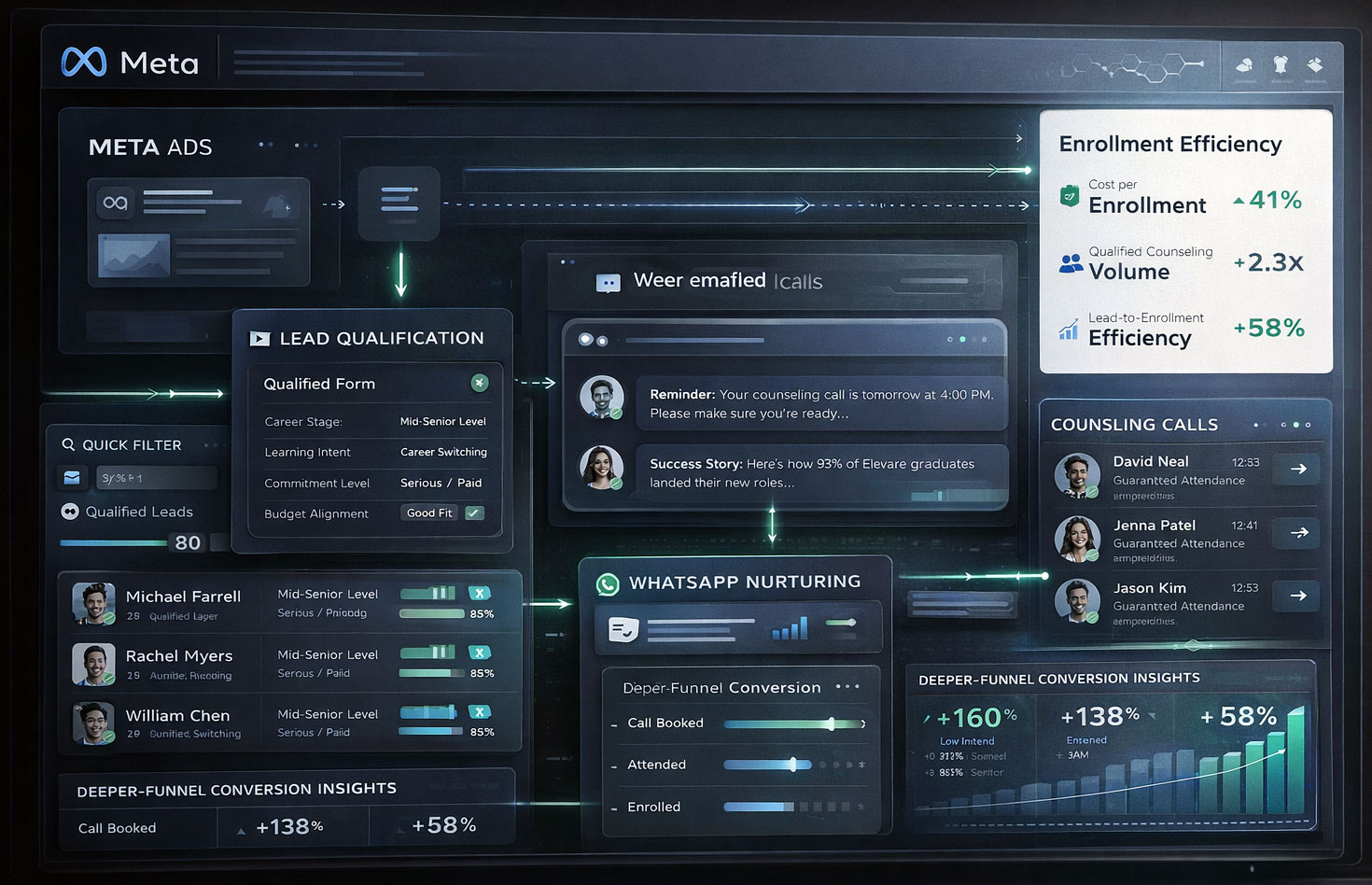
The acquisition system was rebuilt around stronger qualification, better signal quality, tighter message continuity, and higher counseling readiness.
The structural change can be read through four proof lenses: qualification quality, signal quality, intent preservation, and conversion continuity.
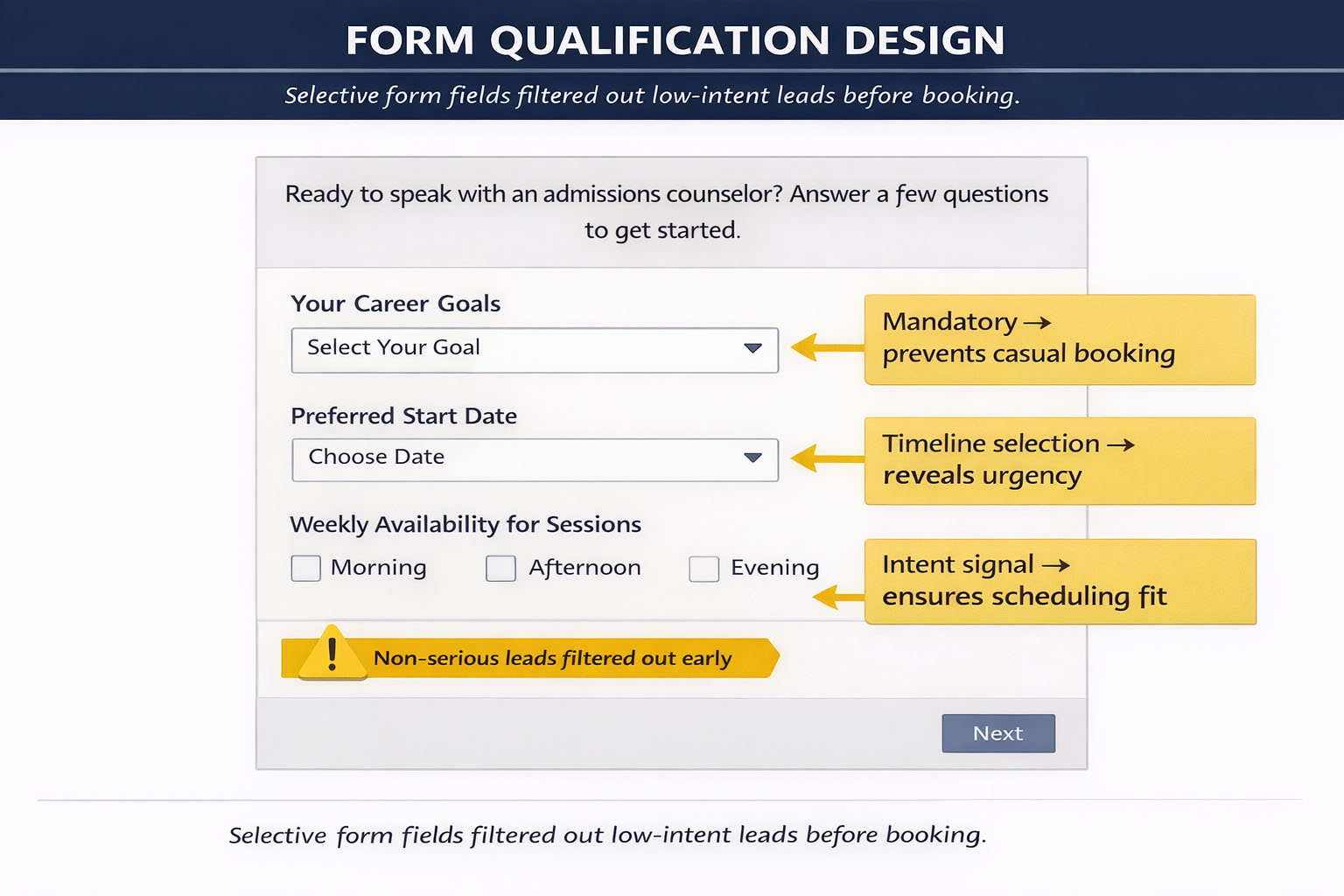
Required qualification fields filtered lower-intent users before counselor time was committed.
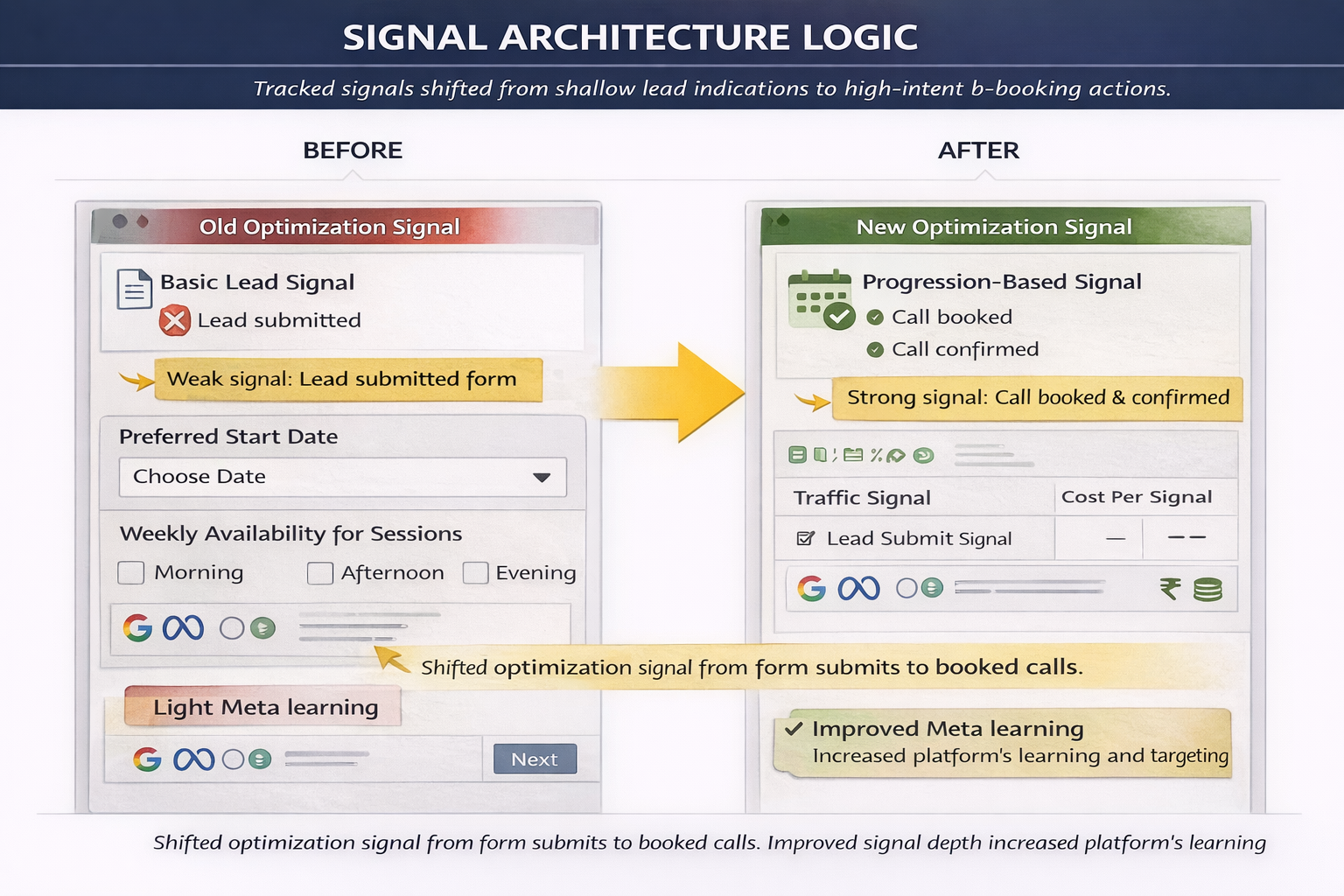
Signal depth improved by moving optimization closer to revenue-relevant progression.
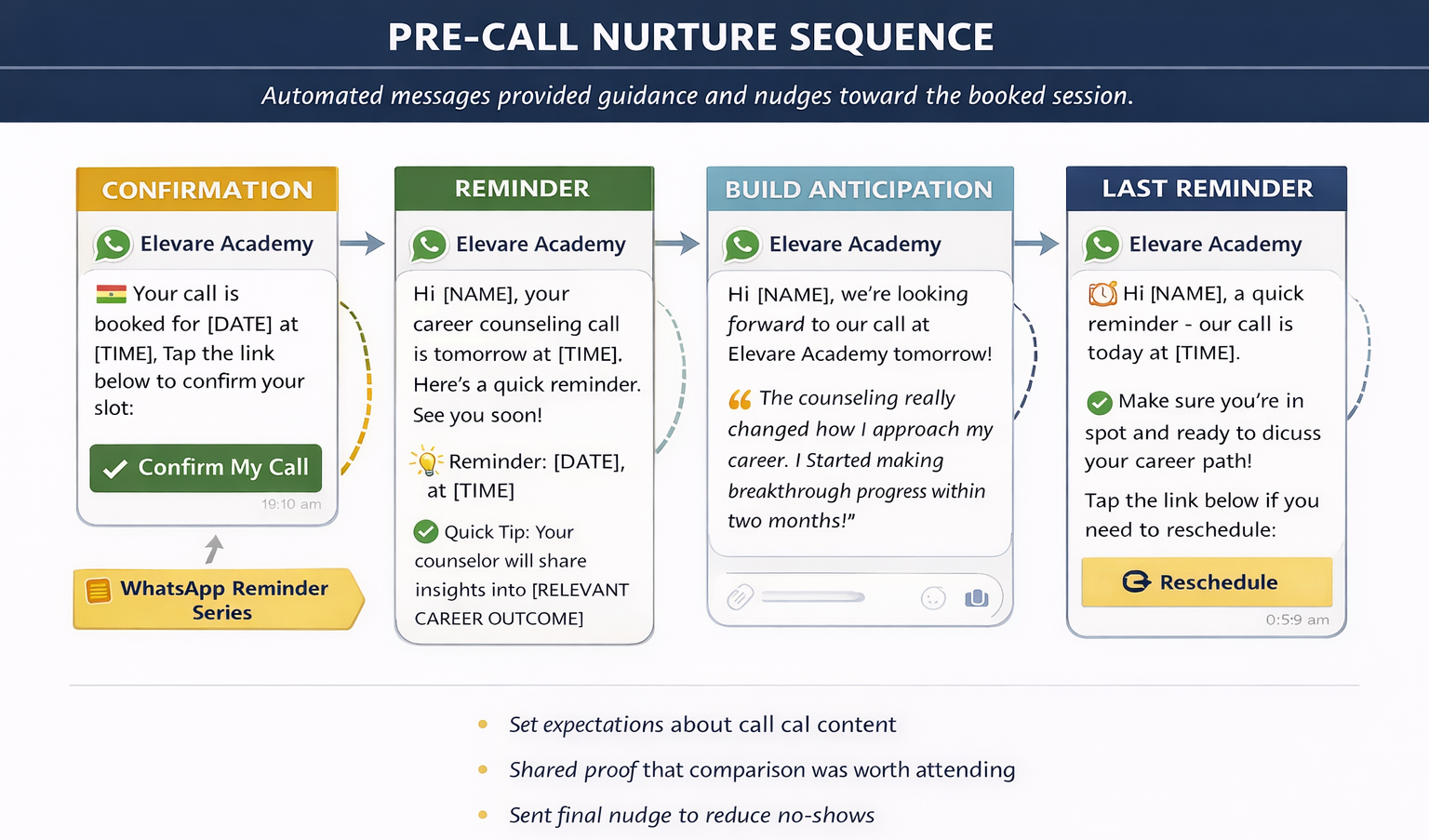
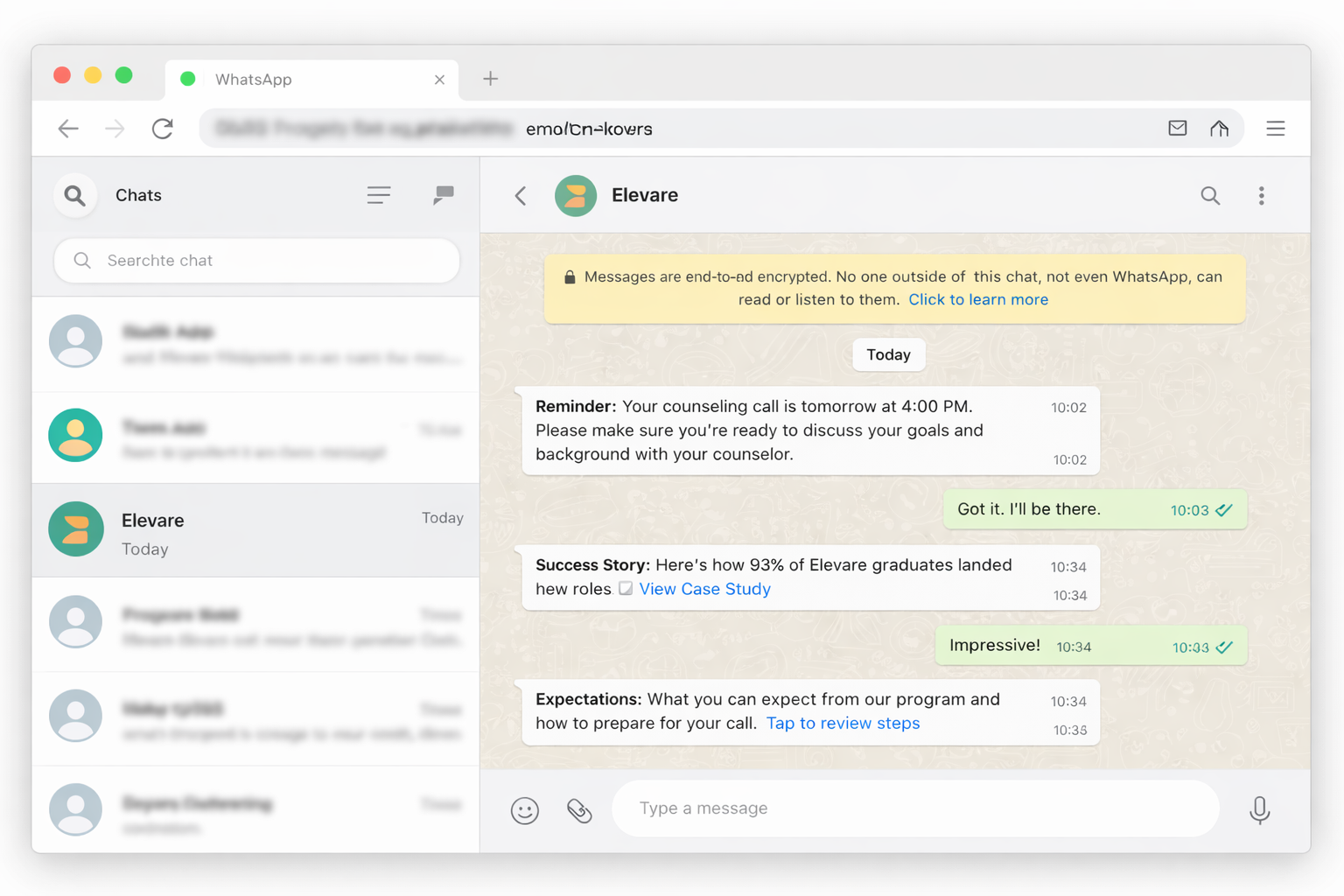
Expectation-setting, reminders, and proof reinforcement reduced intent decay before the counseling call.
Closer message continuity reduced ambiguity and improved trust at the point of action.
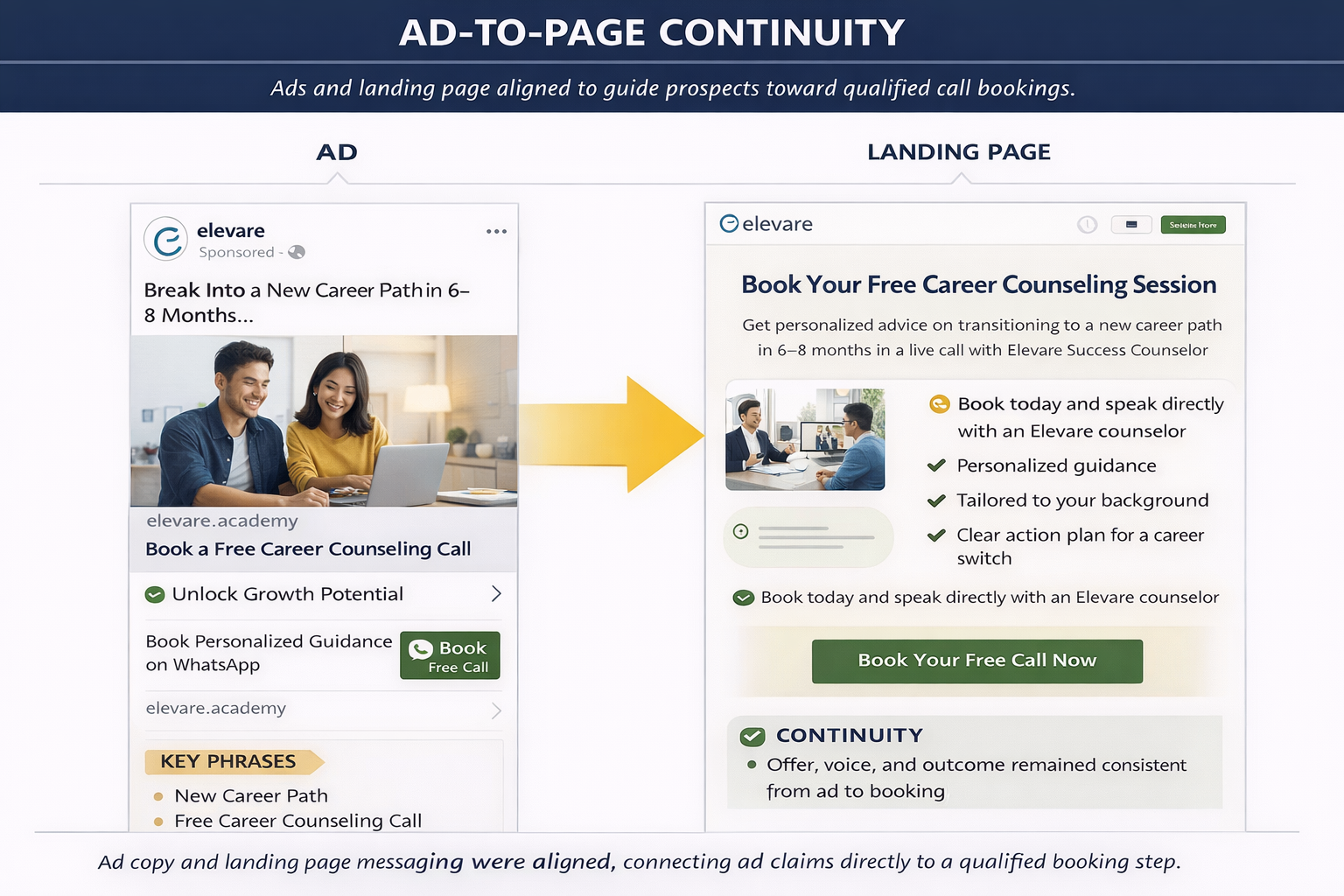
The solution was not to simply improve ads. The account had to be restructured from a loose lead-generation model into an intent-based conversion system.
The first priority was improving the signal quality Meta received. Instead of optimizing purely for top-of-funnel lead submissions, the strategy moved closer to actions tied to qualified counseling progression and enrollment-relevant movement.
The funnel introduced selective friction. Better qualification prompts helped distinguish casual interest from serious program consideration and protect counselor capacity.
Creative and targeting were refined to attract more counseling-intent users rather than broad curiosity traffic. Messaging became clearer around fit, commitment, and program seriousness.
A booked call is not yet a revenue event. To reduce intent decay, the client introduced pre-call WhatsApp nurturing. The sequence reinforced expectation-setting, curriculum clarity, proof points, and reminders before the counseling conversation.
The landing page was aligned more tightly with the ad promise and the actual sales process. The goal was not just higher conversion, but higher-quality conversion.
Within the first 28-day impact window, the funnel improved across the three commercial metrics that mattered most.
| Metric | Before | After | Change | Commercial Meaning |
|---|---|---|---|---|
| Cost per Enrollment | 100 | 59 | 41% Lower | Spend translated into paid students more efficiently. |
| Qualified Counseling Calls | 100 | 230 | 2.3X More | More sales-relevant opportunities entered the funnel. |
| Lead-to-Enrollment Efficiency | 100 | 158 | 58% Higher | A larger share of acquired demand became commercially useful. |
These outcomes matter because efficiency, qualified opportunity flow, and business outcome improved together. That pattern is more consistent with a healthier acquisition system, not just a cheaper one.
These results should be read as a measured 28-day performance window, not as a permanent lifetime average.
For the client, the counseling process became more productive because prospects arrived better informed and more relevant. Conversations could move faster into fit, outcomes, and decision-making instead of re-explaining basics.
That improves counselor productivity and increases the value of existing sales capacity without equivalent headcount expansion.
It would be irresponsible to claim perfect mathematical causality from a 28-day window. But the observed improvement pattern was directionally consistent with the changes introduced during the intervention period:
For a premium EdTech offer, cost per enrollment is more meaningful than lead count or CPC. A 41% reduction here gives the business more room inside its allowable CAC and improves contribution-margin discipline.
The 2.3X increase in qualified counseling calls also matters economically. When more of those conversations are high-intent, the same team can support stronger revenue output without equivalent hiring expansion.
The 58% improvement in lead-to-enrollment efficiency is one of the clearest signs of restored funnel health.
The gain did not come from inventing a new business model. It came from improving how the acquisition system worked.
This was a measured 28-day performance story, not a claim of universal certainty. The strength of the case lies in the alignment of the outcome metrics: lower cost per enrollment, more qualified counseling volume, and stronger lead-to-enrollment efficiency.
The most commercially credible conclusion is simple: the client did not just improve ads. It improved the acquisition system.
This case highlights a common EdTech mistake: confusing lead volume with acquisition health. When Meta is optimized for easy conversions rather than meaningful ones, the business ends up paying for operational friction rather than scalable revenue.
By rebuilding the funnel around lead quality, counseling readiness, better signal feedback, and post-click continuity, the client improved the metrics that serious founders and growth leaders actually care about: cost per enrollment, qualified opportunity flow, and enrollment efficiency.
That is what profitable scaling discipline looks like in Meta-led EdTech growth.
The commercial impact was visible not only in performance metrics but also in how the counseling pipeline began functioning day to day.

“We were generating leads, but most of them weren’t translating into real enrollments. What changed here was not volume — it was quality and intent. Our counseling team started spending time with people who were actually ready to move forward.”
Confidentiality Note:
This engagement was delivered under white-label and NDA constraints. To protect client confidentiality, identifying details, platform screens, and raw data have been anonymized or reconstructed in representative form. The optimization logic, workflow changes, and performance direction shown here reflect the real engagement.
UXGen Technologies, U211, Vaishnav Enclave, Sec. 67A, Dhumaspur Rd, Gurugram, HR 122101
Book a free 30-minute EdTech Funnel Audit. We will review your offer, landing page, lead qualification flow, tracking logic, and counseling journey to identify where intent is breaking, where quality is leaking, and what needs to be fixed first.

