



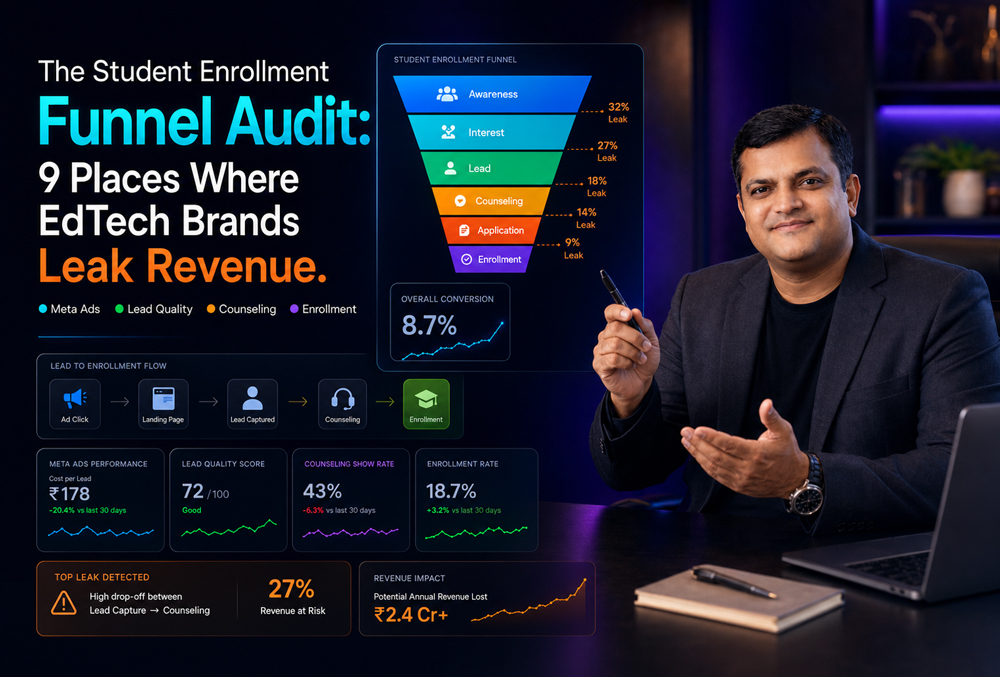
Most EdTech founders think their Meta Ads problem is CPM, CPL, targeting, or creative fatigue. Sometimes it is. But in the vast majority of ad accounts I audit, the bigger problem is not the ad account at all. It is the student enrollment funnel that nobody has audited properly.
You are likely pouring serious capital into Meta Ads every month. The dashboard looks active. Your Cost Per Lead (CPL) might even be stable. Your sales team is busy calling hundreds of prospects a day. But when you look at actual realized revenue and paid enrollments at the end of the month, the math just does not work out.
Your media buyers will blame the algorithm, iOS privacy updates, or “bad audience quality.” Marketing says they are delivering leads; Sales says the leads are garbage.
The hard truth is that Meta Ads only get blamed because the ad spend is visible every single day. The real problem is your funnel architecture.
My core expertise has always been in logical problem-solving and user experience architecture rather than just surface-level visual design. When you apply this exact logical framework to performance marketing, you realize that an ad campaign is essentially a digital product. If the user journey is broken, the product fails. Meta can bring attention. Meta can generate leads. Meta can even find high-intent prospects if the machine learning model has enough clean conversion data. But if the offer is unclear, the landing page lacks trust, the counselor calls late, the CRM does not pass quality signals back, and the payment journey creates hesitation, the campaign will look incredibly expensive-even when the audience targeting is perfect.
In EdTech, the funnel is rarely a simple Ad → Lead → Sale. It is a complex, high-friction psychological journey: Ad → Curiosity → Trust Check → Lead → Qualification → Counselor Call → Objection Handling → Payment → Enrollment.
Tools alone do not solve funnel economics. Your business needs a clean, frictionless path from impression to qualified inquiry, to counseling, to enrollment. Here is a deep dive into the 5 exact places where EdTech enrollment funnels leak revenue, and the strategic fixes required to scale profitably.
1. Optimizing for Curiosity Instead of Commitment
This is the most common and expensive mistake in EdTech performance marketing. The campaign objective is set to generate maximum leads at the lowest possible cost. The dashboard looks highly active, CPL is remarkably low, and the sales team is flooded with data. But actual enrollment volume remains stagnant.
Why does this happen? Because Meta is simply doing exactly what you asked it to do: finding people who are likely to fill out a form, not people who are likely to pay for a high-ticket course.
Many EdTech ads act like clickbait. They use generic hooks like “Learn Digital Marketing in 30 Days!” to generate cheap clicks. Furthermore, if your lead form is too easy-such as using Meta Instant Forms with autofill enabled and zero qualification questions-your sales team will waste hours calling people who cannot afford the program, are not the decision-makers, or simply forgot they even clicked the ad.
When you optimize for sheer volume, you optimize for noise.
The Fix: Move the Optimization Event Closer to Revenue You must introduce strategic friction to filter for intent. A cheap lead comes from curiosity; a qualified lead comes from self-selection.
Stop optimizing for raw form submissions. Move your conversion event down the funnel to actions like “Qualified Lead” or “Counseling Call Booked.” Add mandatory qualification questions to your lead forms that force the user to think before submitting.
Effective qualification questions include:
- What is your current professional role or education stage?
- When are you looking to start your upskilling journey?
- Are you comfortable with the tuition range of X to Y?
By filtering out the casual scrollers, your CPL will naturally increase. However, your Cost Per Enrollment (CPE)-the only metric that actually matters to your bottom line-will decrease because your sales team is only speaking to high-intent prospects.
2. The Pre-Click to Post-Click Disconnect
A learner clicks your ad because the creative made a very specific promise. They have a specific pain point, and your ad offered a specific solution. If they click through and the landing page suddenly becomes generic, trust drops instantly, and the user bounces.
Imagine an ad targeting junior designers that says, “Become job-ready in UX without coding-Master advanced prototyping.” The user clicks, expecting to see a curriculum about advanced prototyping and UX logic. Instead, they land on a generic homepage that says, “Welcome to our academy. We provide professional digital courses.”
You have just killed all momentum. The user feels misled and leaves.
The Fix: Architect a High-Trust Landing Page A proper EdTech landing page must achieve absolute continuity with the ad creative. The headline of the landing page must mirror the hook of the ad. Beyond that, the page must immediately answer the buyer’s silent, internal objections within the first 10 seconds:
- Who is teaching this? Showcase instructor authority, real-world experience, and industry credentials.
- What is the realistic outcome? Do not sell modules; sell the transformation. Highlight specific career outcomes, average salary hikes, or portfolio improvements.
- Where is the proof? Embed video testimonials, verified alumni LinkedIn profiles, and hiring partner logos above the fold.
- What is the risk? Clarify refund policies, job guarantees (if applicable), and support structures.
When the post-click experience perfectly matches the pre-click expectation, conversion rates stabilize.
3. The Sales Handoff and Counseling Failure
In the EdTech industry, lead intent decays exponentially. It does not decay in days; it decays in minutes.
If a student submits your inquiry form while they are actively comparing three different coding bootcamps, and your counselor calls them 24 hours later, the emotional window is already closed. They have likely already spoken to a competitor who called them within five minutes.
When your team finally does connect, the conversation is often fundamentally flawed. Most EdTech counselors sound like walking brochures. They immediately start listing curriculum modules, course durations, and payment plans. Serious students are not just buying modules; they are buying career confidence and risk reduction.
The Fix: Implement Diagnostic Counseling First, fix the operational speed. You must implement an automated, fast follow-up system. The moment a lead is captured, they should receive an instant WhatsApp confirmation setting expectations, and a human counselor should make the first call attempt within 15 minutes.
Second, train your counseling team to stop pitching features and start diagnosing problems.
A highly effective counseling call should look like this:
- Opening: Do not say, “You filled our form.” Say, “I saw you are exploring a career transition into Data Analytics. Let me understand your current stage.”
- Diagnosis: Uncover the current skill gap, budget readiness, urgency level, and what other options they are considering.
- Prescription: Recommend the program strictly based on the gaps identified in the diagnosis.
- Objection Handling: Address the unspoken fears. If they hesitate on price, it is usually a fear of ROI, not a lack of funds.
The counselor’s job is not to sell the course. The job is to move the prospect from career confusion to decision clarity.
4. Generic, Unsegmented Retargeting
Take a look at your current retargeting campaigns. If you are like most EdTech brands, you are taking every single person who visited your website in the last 30 days, putting them in one massive audience pool, and hitting them with the exact same message: “Admissions closing soon! Enroll Now!”
This is lazy media buying, and it burns budget rapidly.
If a prospect attended a 45-minute live webinar but did not buy, shouting “Enroll Now” at them repeatedly does not solve their hesitation. They did not forget to buy; they chose not to. They likely have an unspoken objection about the price, the time commitment required, or your brand’s overall credibility.
The Fix: Map Retargeting to the Funnel Stage Retargeting must be segmented based on the prospect’s exact behavioral stage in the funnel. You need to answer the next specific doubt, not just repeat the Call to Action.
- Stage 1 (Visited the course page but did not inquire): They need to know the outcome is real. Show them short, punchy video testimonials from alumni who were in their exact situation 6 months ago.
- Stage 2 (Submitted a lead but missed the counselor call): They need urgency and convenience. Push ads highlighting a direct WhatsApp link to reschedule their career counseling session easily.
- Stage 3 (Attended the counseling call or visited the fee section but did not pay): They are dealing with financial risk and hesitation. Show them ROI data, explain EMI financing options clearly, and highlight your money-back guarantee or placement support to reduce the perceived risk.
5. Blind Scaling Due to Broken CRM Tracking
This is where performance marketing becomes a serious business operation. If Meta’s machine learning algorithm only sees the top-of-funnel action (the lead submission) but has absolutely zero visibility into the deep-funnel revenue metrics (counseling calls attended, payments completed, high-LTV enrollments), scaling your ad spend becomes complete guesswork.
If a founder only looks at the ad dashboard and sees 2,000 leads generated at $2 each, they might think the campaign is a massive success. But if the CRM shows that 1,500 of those leads were completely unqualified and only 10 actually enrolled, the data is useless.
When you increase the budget on a campaign that only tracks top-of-funnel leads, Meta will just find you more of those low-quality form fillers faster.
The Fix: Close the Loop with Conversions API Relying solely on the Meta Pixel installed on your website browser is no longer sufficient due to ad blockers and privacy restrictions. Implementing the Meta Conversions API (CAPI) is non-negotiable for serious scaling.
You must create a direct, server-side connection between your CRM and Meta’s optimization systems. When a lead moves to “Call Attended” or “Payment Completed” in your CRM, that data must be fired back to Meta in real-time.
When you feed offline conversion data back into the system, you train the algorithm to look for behavioral patterns associated with actual buyers, instead of just people who like clicking on ads. This is how you transition from buying cheap leads to acquiring profitable students.
Why UXGen Metalabs Is the Best Partner for Solving This
At UXGen Metalabs, we are built for EdTech brands and enterprise clients who do not want cheaper clicks. They want cleaner funnel intelligence, superior enrollment economics, and scalable Meta campaign architecture.
As the CTO and co-founder, my approach to performance marketing is deeply rooted in systems logic. We are specialists in Meta Campaign Audits and Performance Intelligence. That means we do not just look at your ad creatives and audience targeting. We diagnose the entire revenue path.
We audit offer positioning, landing page friction, the sales handoff, CRM visibility, and server-side tracking integrity. Most typical marketing agencies will send you a weekly report celebrating a drop in Cost Per Lead. We ask a far more critical business question: Which specific campaign is producing students who actually convert, pay the full fee, and create long-term business momentum?
Case Study: Re-engineering an EdTech Enrollment System
- Client Context: A mid-size EdTech brand running career-focused online programs was spending heavily on Meta Ads. The ad account was generating a high volume of leads at an acceptable CPL, but paid enrollments had hit a hard ceiling. The sales team was exhausted from calling unqualified prospects.
- Our Diagnosis: The funnel was optimizing for sheer lead volume. Retargeting was completely unsegmented. Most critically, Meta was operating blindly because it was not receiving any qualified lead or enrollment feedback from the client’s CRM.
- The Approach: We entirely rebuilt the ad messaging to focus on specific learner outcomes rather than course features. We added intent-based qualification logic to the lead forms to filter out casual clicks. We restructured the CRM to track specific drop-off stages and implemented the Meta Conversions API to send “Call Attended” and “Payment Link Sent” events directly back to the ad account.
- The Outcome: Within 28 days of implementing this logical funnel architecture, the client’s fully loaded Cost Per Enrollment dropped by 41%. Qualified counseling calls increased by 2.3x, and overall lead-to-enrollment efficiency improved by 58% without increasing the total ad spend.
Frequently Asked Questions
What exactly is a student enrollment funnel audit?
A student enrollment funnel audit is a comprehensive, diagnostic review of every single touchpoint a prospective student interacts with before paying their tuition. It goes far beyond the ad account to cover landing page friction, lead form intent filtering, CRM tracking integrity, counselor follow-up speed, and retargeting logic. The primary goal is to identify exactly where high-intent prospects are dropping off and patch those hidden revenue leaks.
Why are my EdTech Meta Ads generating leads but zero enrollments?
This is the most common symptom of a funnel optimized for volume rather than intent. Your ads are likely attracting curious scrollers with vague promises. If your landing page fails to build trust, your sales team takes 24 hours to call them, or your CRM doesn’t feed “qualified lead” data back to Meta’s algorithm, those top-of-funnel leads will never convert into paying students.
How can I make Meta Ads improve my actual student enrollment quality?
You must utilize better data feedback loops. Generating good leads requires training the algorithm. When you connect your CRM directly to Meta via the Conversions API (CAPI), you can send deep-funnel signals-like “Counseling Attended” or “Payment Completed”-back to the platform. This trains Meta to find people with similar behavioral and purchasing patterns to your actual enrolled students.
What performance metrics should an EdTech founder track beyond CPL?
Cost Per Lead is essentially a vanity metric if those leads do not eventually buy. To understand true marketing health, you must track your Qualified Lead Ratio, Call Connection Rate, Counseling Attendance Rate, fully loaded Cost Per Enrollment (CPE), Lead-to-Enrollment Conversion Rate, and ultimately, your Return on Ad Spend (ROAS).
Should EdTech brands use Meta Instant Forms or direct traffic to Landing Pages?
Both have strategic uses. Instant forms are highly effective for capturing volume quickly, but they often result in lower-quality leads unless you add custom qualification questions. Directing traffic to a well-architected landing page creates more friction, which lowers lead volume but significantly increases lead intent. For high-ticket EdTech programs, a strong landing page usually creates the required trust and context needed for a strong sales conversation.
What is the single biggest revenue leak in EdTech marketing today?
The operational gap between lead generation and enrollment conversion. Many EdTech brands are willing to spend massive budgets to generate leads, but they fail to track qualification metrics, monitor counseling call quality, document objection patterns, or map payment drop-offs properly. This creates an expensive illusion of marketing activity without generating true enrollment efficiency.
How often should an EdTech company audit its marketing funnel?
Surface-level performance metrics should be reviewed weekly. However, a deep, structural funnel audit should be conducted every 30 to 45 days. This is especially critical when ad spend is scaling up, CPL is suddenly rising, lead quality is noticeably dropping, or when launching a completely new course category.
Stop Guessing, Start Scaling Profitably
Your Meta Ads may not be failing. Your funnel is simply leaking.
Continuing to swap out ad creatives, test new audiences, and increase daily budgets without fixing the underlying enrollment journey will only multiply your losses at scale. If the core offer is unclear, the landing page is weak, the lead form attracts low-intent individuals, the counselor follow-up is slow, and Meta is not receiving quality data signals, scaling your spend will just burn capital faster.
You cannot fix a fundamental business economics problem by tweaking an ad campaign. You need an executive-grade, logical view of your performance marketing architecture to see exactly where your revenue is getting stuck.
Stop judging your marketing performance by the cost of a lead. Start optimizing for the cost of a retained student.
Ready to fix your funnel economics and scale with absolute clarity? Book a Campaign Audit with UXGen Metalabs today.
About the Author