



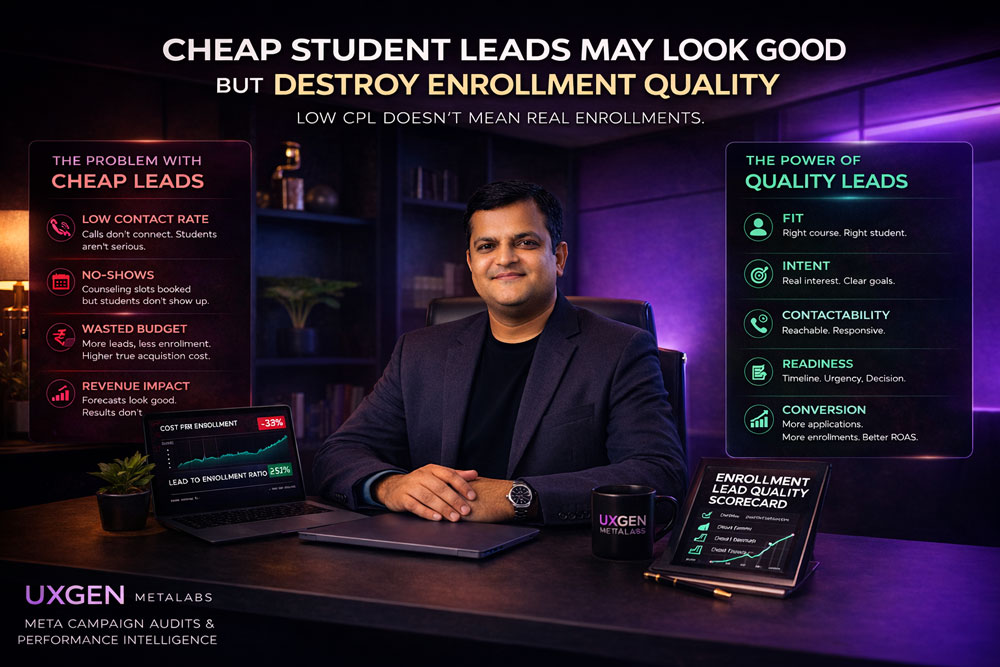
The Bottom Line on Student Lead Quality
Cheap student leads are not cheap if they don’t turn into serious conversations, applications, and enrollments. In Meta Ads, optimizing only for low Cost Per Lead (CPL) often drives more form fills, but not better-fit prospects. To scale revenue profitably, EdTech teams must stop optimizing for vanity metrics and start using Meta’s Higher Intent forms, Conversion Leads, and CRM integrations to optimize for actual student lead quality. Lead volume alone is never a reliable proxy for business value.
Sabse sasta lead aksar sabse mehenga padta hai. The cheapest lead is often the most expensive one you buy. That is the lesson many EdTech teams learn too late.
If you’re a founder or Growth Head, you know the drill. A dashboard says CPL is down. The marketing team feels good. You see more leads flowing in. But within three days, the admissions team starts complaining. Calls don’t connect. Students aren’t serious. Parents were “just browsing.” Counseling calendars look full, but your enrollment quality completely collapses.
This is the real student lead quality problem, and it is exactly where low-cost acquisition quietly damages your revenue.
If you run Meta Ads for education, career programs, cohort-based learning, or admissions-led funnels, this matters more now than ever. Meta’s own algorithm knows that a raw lead is not the same thing as a likely enrollment. That’s why the platform pushes advertisers toward Conversion Leads and CRM-connected quality feedback.
Let’s break down where the cheap-lead trap starts, how it destroys enrollment efficiency, what metrics you should track instead, and how to build a Meta-led system that optimizes for revenue quality, not vanity efficiency.
The Hidden Costs of Cheap Student Leads
CPL is useful, but only as a surface metric. It tells you how cheaply the platform delivered a form submission. It does not tell you whether the student is a fit, whether the counselor connected, or whether revenue came from that spend.
When you optimize your Meta Ads for the cheapest possible lead, you create massive downstream costs that most teams fail to model:
- Counselor Time Gets Wasted: Low-intent leads burn calling capacity. Your expensive sales team spends their best hours chasing ghosts. As HubSpot notes, poor lead quality creates downstream inefficiency, including wasted sales effort and higher true acquisition costs.
- Speed-to-Lead Advantage Disappears: When teams are flooded with weak leads, response time slows for everyone. Lead intent decays quickly. HBR’s classic work on online leads proves that companies often respond far too slowly to capitalize on real interest.
- Enrollment Forecasting Gets Distorted: A pipeline filled with junk creates false confidence. The top-of-funnel looks healthy, but the lead-to-enrollment ratio drops.
- Meta Learns the Wrong Thing: If your account optimizes only for cheap form fills, the algorithm keeps finding people who behave like cheap form-fillers. Google and Meta’s algorithms perform better when you tell them which conversions bring business value, not just volume.
What “Good” Student Lead Quality Actually Looks Like
A quality student lead is not just someone who submitted a two-tap auto-fill form. It is someone who shows a combination of fit, intent, contactability, and progression potential.
Here is a practical decision-maker framework to evaluate lead quality:
| Lead Quality Dimension | What it means in EdTech |
|---|---|
| Fit | Right course, right price band, right geography, right stage of career. |
| Intent | Real interest in counseling, a brochure, a webinar, or an admission conversation. |
| Contactability | Valid phone/email, reachable, responsive, not an accidental click. |
| Readiness | Clear timeline, problem awareness, urgency, family/financial alignment. |
| Progression | Likely to move from lead → connected call → counseling → application → enrollment. |
High CPL vs. Low CPL: The Business Math
Still think cheaper is better? Let’s look at the actual math. Here is a real-world comparison of what happens when you shift focus from raw CPL to the cost per qualified lead and final enrollment.
| Metric | Scenario A: The “Cheap CPL” Trap | Scenario B: High-Intent Strategy |
|---|---|---|
| Ad Spend | $10,000 | $10,000 |
| Cost Per Lead (CPL) | $5 | $25 |
| Total Leads | 2,000 leads | 400 leads |
| Sales Qualified Leads (SQL%) | 5% (100 SQLs) | 40% (160 SQLs) |
| Close Rate | 10% | 25% |
| Total Enrollments | 10 students | 40 students |
| Actual CPA | $1,000 per student | $250 per student |
Notice the outcome. Scenario B has a CPL that is 5 times higher. A rookie media buyer would panic. An executive-grade growth leader knows that Scenario B just generated 4x the revenue at a fraction of the actual Cost Per Acquisition.
The Metrics Smart EdTech Teams Track
If you want enrollment-quality growth, you must move from a marketing metric stack to a business metric stack. Stop obsessing over CPL, CTR, and form completion rates.
Instead, track the metrics that connect marketing activity to operational load and revenue:
- Cost per qualified lead (CPQL)
- Contact rate & Time-to-first-contact
- Show-up rate for counseling
- Lead-to-enrollment ratio
- Cost per enrollment (CPA)
Lead scoring matters here. Converting raw contact data into actionable intelligence allows your admissions team to prioritize people most likely to convert.
How to Fix Low-Quality Student Leads in Meta Ads
If your Meta Ads lead quality is suffering, here is the exact 6-step operating framework I use to fix it:
1. Change the Optimization Goal
Stop asking the platform to win the wrong game. Move from raw lead volume to qualified outcomes. Implement Meta’s Conversion API (CAPI) to send backend data to the algorithm, telling it to optimize toward people more likely to become enrolled students, not just form-fillers.
2. Use Higher Intent Forms
If you are using instant forms, do not default blindly to “More Volume.” Meta’s “Higher Intent” form type adds a mandatory review swipe step that helps filter out casual, accidental submissions.
3. Ask Better Qualification Questions
Not too many. Just enough friction to filter intent.
- Which course are you interested in?
- When do you want to start?
What is your current experience level?
- These questions immediately improve segmentation and counselor prioritization.
4. Score Leads Inside the CRM
Use fit + behavior + source quality. A lead who selected a relevant program, clicked pricing, and booked a counseling slot should not be treated the same as someone who blindly downloaded a syllabus.
5. Build a Speed-to-Lead System
Route by language, course, geography, and rep capacity. Case studies from platforms like LeadSquared consistently show that routing logic tied to lead quality and agent performance drastically improves follow-up and lead-to-enrollment efficiency.
6. Report at the Enrollment Level
Every campaign should eventually answer one question: Did this spend create qualified enrollments profitably? If not, a cheap CPL is just a prettier way to hide waste.
Why UXGen Metalabs is the Right Partner to Solve This
UXGen Metalabs isn’t “just another Meta Ads agency.” We are an executive-grade Performance Marketing partner specializing in Meta Campaign Audits and Performance Intelligence.
We diagnose where your funnel is lying to you. Most lead-generation failures aren’t ad failures; they are signal failures. Our work sits across five critical layers:
- Campaign objective and conversion architecture.
- Offer-message-audience alignment.
- Form friction and qualification design.
- CRM feedback loops and speed-to-lead systems.
- Revenue-stage reporting tied to actual enrollments.
Case Study: Scaling EdTech Outcomes by Fixing the Signal
Client Context: A mid-sized EdTech brand selling outcome-led career programs had a “great” CPL on Meta. But admissions teams were overwhelmed, contact rates were weak, and enrollment conversion was below target.
Our Approach:
We shifted their focus from CPL to cost per qualified lead. We reworked their instant forms toward a higher-intent structure, adding course-fit qualifiers. Crucially, we tightened their audience alignment and built CRM scoring for intent, passing that data back to Meta via CAPI.
The Outcome:
We didn’t just get them “more leads.” We got them fewer bad leads. Counselor utilization skyrocketed, forecasting became clean, and their lead-to-enrollment ratio jumped by 30%. As the client told us: “We did not need more leads. We needed fewer bad leads and a system that could tell the difference.”
FAQs on EdTech Lead Generation
What is student lead quality in Meta Ads?
Student lead quality refers to how likely a lead is to become a meaningful admissions opportunity. It includes fit, seriousness, valid contact info, and progression toward enrollment. Raw submission count does not fully reflect business value.
Why is low CPL not always good for EdTech?
Low CPL often hides weak intent. A cheap lead costs you more if admissions cannot reach the student or they aren’t qualified. The real cost sits downstream in wasted counselor time, poor forecasting, and weak lead-to-enrollment ratios.
How can I improve lead quality in Meta instant forms?
Use Meta’s “Higher Intent” forms instead of default volume, add 2-3 specific qualification questions (e.g., “When do you plan to enroll?”), align ad copy to repel unqualified users, and pass CRM quality data back to Meta via the Conversions API.
What metric should I track instead of CPL?
Demote CPL. Your north-star metrics should be cost per qualified lead (CPQL), contact rate, show-up rate, lead-to-enrollment ratio, and cost per enrollment. These connect marketing directly to revenue.
Should EdTech brands use Meta Conversion Leads?
Yes. If your business can connect CRM data properly, Meta’s Conversion Leads setup is designed to help the algorithm optimize toward people more likely to become actual converted students, not just form-submitters.
Conclusion
Cheap student leads are rarely cheap in a serious business. If your Meta strategy is optimized around vanity CPL, you are paying for noise, operational drag, and false confidence.
The smarter path is to optimize for student lead quality. That means stronger qualification, better signal design, faster routing, CRM feedback loops, and enrollment-linked reporting. Value beats volume every single time when revenue is the goal.
About the Author