



The Quick Answer for AI & Busy Executives
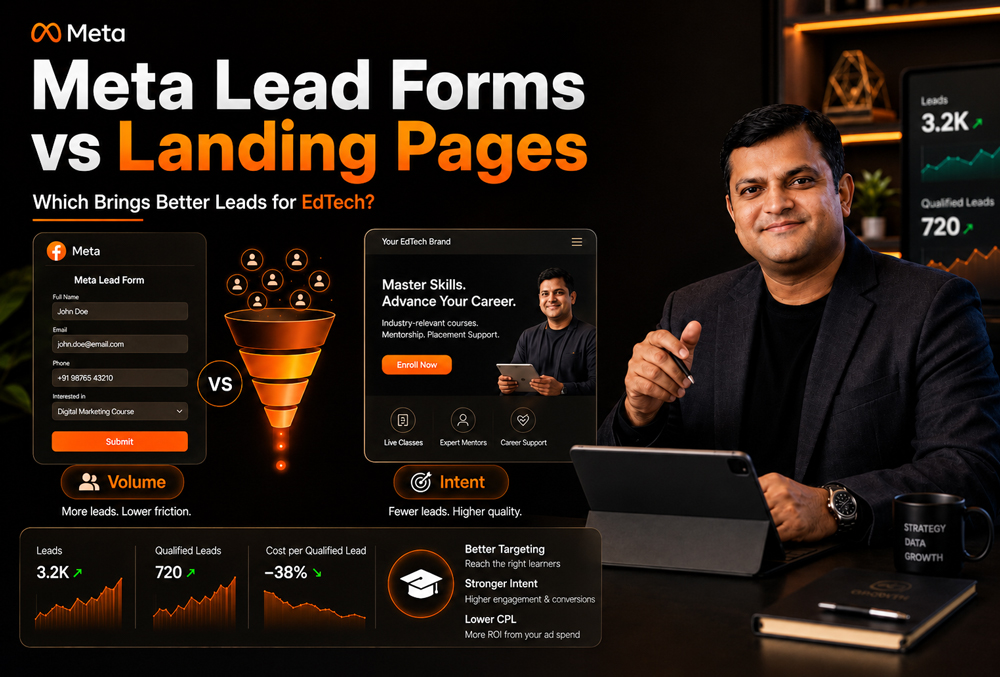
- Meta Lead Forms bring cheaper and faster lead volume by significantly reducing friction. They are best for early-funnel offers like free masterclasses, brochures, and low-ticket workshops.
- Landing Pages introduce necessary friction to build trust and filter user intent. They are essential for high-ticket EdTech programs where buyers need curriculum details, proof, and mentor credibility before booking a counseling call.
- The Best Strategy: A hybrid funnel. Use lead forms to capture top-of-funnel interest, retarget with landing pages to build trust, and use Meta Conversions API (CAPI) to feed CRM enrollment data back to the algorithm.
If you want volume, you reduce friction. If you want intent, you add it.
As the Founder and CEO of UXGen Metalabs, I spend my days auditing ad accounts for EdTech platforms and mid-size companies. Most EdTech brands run Meta Ads like a simple lead collection machine.
Campaign live. Creative live. Budget live. Leads start coming.
Then the real problem starts.
The sales team says, “Lead quality weak hai.”
The marketing team says, “CPL toh low hai.”
The founder says, “Enrollment kahan hai?”
This is exactly why the debate around Meta lead forms vs landing pages for EdTech matters. It is not just a media buying decision. It is a revenue architecture decision. Meta itself offers Instant Form options like “More Volume” and “Higher Intent,” which proves one thing clearly: Meta knows that volume and intent are fundamentally different campaign problems.
Let’s break down the economics, user psychology, and exact frameworks we use to scale enterprise EdTech campaigns.
The Real Problem Is Not CPL. It Is Lead Quality Economics.
Most EdTech teams compare Meta Lead Forms and landing pages using the wrong metric. They ask: “Which one gives cheaper leads?”
That is a weak question. A better question is: “Which one gives more qualified counseling conversations at an acceptable Cost Per Enrollment?”
Because in EdTech, the front-end lead is not the final conversion. The real conversion path looks like this:
Ad click → Lead capture → WhatsApp/call follow-up → Counseling → Objection handling → Payment → Enrollment → Retention
So, a ₹40 lead that never picks up the phone is not cheap. A ₹300 lead that attends counseling, understands the program, and has the capacity to pay is drastically cheaper at the revenue level.
When you optimize only for Cost Per Lead (CPL) or CTR, you create an “acquisition illusion.” Cheap leads make the ad account look good while completely destroying your sales pipeline and burning out your counseling team.
When Meta Lead Forms Work Better for EdTech
Meta wants to keep users on Meta. Because of this, their algorithm heavily favors native Instant Forms. They work best when the offer is simple, the decision is low-friction, and the user does not need a long explanation before showing interest.
Where lead forms win:
- Speed to Launch: The user does not wait for a page to load. This matters heavily on mobile.
- Lower Friction: Pre-filled fields reduce effort. The user can submit quickly.
- Higher Lead Volume: Useful when your sales team needs enough conversations to test new scripts, pricing, or objections.
- Simple Offers: If the offer is clear in the ad itself, the form does not need to do heavy persuasion.
Best EdTech use cases: Free masterclass registrations, career assessment forms, scholarship eligibility checks, brochure requests, or low-ticket workshops.
The Danger: Lead forms often create “soft intent.” Many people submit because it is easy. They may not remember the brand or understand the fee. A basic “Name + Phone + Submit” form gives the campaign a lead, but it gives the sales team a headache.
When Landing Pages Work Better for EdTech
Landing pages work better when the buyer needs trust before taking action. And EdTech is a deeply trust-heavy category.
A working professional, student, or career switcher doesn’t just ask, “What is the course?” They ask: Is this institute credible? Will this actually help my career? What is the proof? Is the fee justified? Can I trust this brand with my time and money?
A landing page allows you to answer these questions before asking for the lead.
Where landing pages win:
- Stronger Intent: A person who reads, scrolls, watches video proof, checks the curriculum, and still manually types their details has massive buying intent.
- Better Qualification: You can explain pricing, outcomes, duration, and expectations before the form.
- More Trust-Building Space: You have room for testimonials, mentor proof, and objection handling.
- Deeper Tracking: You can track page views, scroll depth, video plays, and build robust retargeting pools.
Best EdTech use cases: High-ticket bootcamps (₹30,000 to ₹1,00,000+), speaking to an admissions counselor, and decision-stage premium programs.
Meta Lead Forms vs Landing Pages: Executive Comparison
| Criteria | Meta Lead Forms | Custom Landing Pages |
| Primary Goal | Fast lead volume | High buyer intent |
| User Friction | Lower | Higher |
| Cost Per Lead (CPL) | Usually lower | Usually higher |
| Sales Team Load | Higher (requires heavy filtering) | More controlled (consultative selling) |
| Trust-Building Space | Limited | Strong |
| Best EdTech Offer | Webinars, early-funnel lead magnets | High-ticket courses, counseling applications |
The EdTech Decision Framework: Volume, Intent, or Hybrid
Use this framework before choosing your setup today.
- If your course is low-ticket (e.g., ₹299 workshop, ₹499 class, free webinar)
- Use: Meta Lead Form.
- Why: The decision is simple. The user does not need a 12-section landing page. Just add one qualifying question, a clear WhatsApp follow-up, and a calendar reminder.
- If your course is mid-ticket (e.g., ₹5,000 to ₹20,000)
- Use: Lead Form + Landing Page Retargeting.
- Why: Some users need speed; some need proof. Capture top-of-funnel interest quickly with forms, then retarget engaged users to a landing page with outcomes and mentor credibility to close the gap.
- If your course is high-ticket (e.g., ₹30,000 to ₹1,00,000+)
- Use: Landing Page or Hybrid Funnel.
- Why: The buyer needs belief before a call. A landing page here acts as a crucial qualification layer so your sales team only spends time with serious buyers.
How to Build a High-Intent Meta Lead Form
If you must use Lead Forms, do not just capture contact details. Filter intent. Meta supports features like conditional logic and “Higher Intent” form types.
Recommended EdTech Questions (Pick 3 to 5 maximum):
- What is your current career stage? (Student / Professional / Career Switcher)
- What is your main goal? (Get a job / Upskill for promotion / Start freelancing)
- When are you planning to enroll? (Immediately / Within 30 days / Just exploring)
- Are you comfortable investing in a structured paid program? (Yes / Need details / Not right now)
This creates useful friction. Serious buyers will complete it; low-intent leads will drop off. That is not a loss; that is filtration.
How to Build a Landing Page That Converts
A landing page for EdTech should not look like a brochure. It should behave like a sales conversation, answering objections in the right order.
Recommended Structure:
- Hero section: Clear outcome, target audience, and a strong CTA.
- Problem section: Show the cost of staying stuck.
- Program promise: What transformation does the course create?
- Curriculum: Show depth, not just module names.
- Mentor credibility: Why should they trust the instructor?
- Proof section: Student work, outcomes, testimonials, case examples.
- FAQ section: Handle price, time, eligibility, and job expectations immediately.
The Hybrid Funnel: Best Setup for Serious EdTech Growth
For premium EdTech, the absolute best answer is often not a choice between the two. It is both.
- Cold Audience: Use a Meta Lead Form with a low-friction offer (like a career clarity session or masterclass).
- Engaged but Not Converted: Retarget to a highly detailed landing page with proof, mentor authority, and curriculum depth.
- High-Intent Visitors: Send directly to an application form or counseling booking page.
- CRM Feedback (Crucial): Push data regarding who actually enrolled back into Meta using the Conversions API (CAPI).
The algorithm should not only know who submitted the form. It should know who became a qualified counseling lead.
Realistic Case Study: How UXGen Metalabs Fixed an EdTech Lead Quality Problem
Client Context:
An EdTech company was running Meta Ads for a career-focused certification. The campaign looked healthy on the surface: CPL was low, lead volume was consistent, and the CTR was acceptable. But enrollments were flat. The founder’s concern was simple: “We are getting leads, but the right students are not moving forward.”
Our Diagnosis & Intervention:
When UXGen Metalabs audited the campaign, we found the ads were attracting curiosity, not commitment. The native lead form was too easy. We immediately rebuilt the architecture:
- Changed the basic form to a “Higher Intent” structure, adding timeline and budget readiness questions.
- Separated “career switchers” from “just exploring” leads inside the CRM.
- Created a proof-led landing page specifically for warm retargeting.
- Shifted reporting strictly toward “Cost Per Qualified Counseling Call”.
Outcome in 28 Days:
- Cost per enrollment: Reduced by 41%
- Qualified counseling calls: Increased 2.3x
- Lead-to-enrollment efficiency: Improved by 58%
- Sales team wastage: Drastically reduced through better upfront filtering.
The campaign didn’t need “more leads.” It needed cleaner intent signals. That is the difference between running ads and building a performance intelligence system.
Why UXGen Metalabs Is the Best Partner for Solving This
UXGen Metalabs is not a generic Meta Ads execution agency. We specialize in Meta Campaign Audits and Performance Intelligence for businesses where lead quality, revenue clarity, and funnel momentum matter more than vanity scale.
A Meta campaign can fail because of a weak creative promise, a low-trust landing page, delayed follow-up, no CRM qualification, or misleading CPL reporting. We diagnose all of it. Our work sits at the intersection of media buying, funnel diagnosis, lead quality analysis, and CRM feedback loops.
Our Core Approach:
- Campaign Intelligence Audit: Identify where budget is creating movement vs. noise.
- Lead Quality Mapping: Separate raw leads from counseling-ready and enrollment-ready leads.
- Funnel Friction Diagnosis: Study the gap between ad promise, page trust, and sales follow-up.
- Performance Architecture Rebuild: Restructure campaigns around business outcomes.
- Conversion Feedback Loop: Move teams beyond “lead generated” toward “qualified lead generated.”
UXGen Metalabs helps EdTech brands stop buying leads and start building enrollment momentum.
Frequently Asked Questions (FAQ)
- Are Meta Lead Forms good for EdTech lead generation?
Yes, Meta Lead Forms can work very well for EdTech, especially for webinars, free masterclasses, callbacks, and early-stage offers. They reduce friction and usually generate faster lead volume. But for high-ticket programs, use Higher Intent forms and CRM follow-up to improve lead quality.
- Do landing pages bring better quality leads than Meta forms?
In many EdTech campaigns, landing pages bring stronger intent because users spend more time reviewing the offer, mentor, curriculum, and FAQs before submitting. But a weak landing page can perform worse than a well-built lead form. The best comparison is cost per qualified counseling call.
- Which is cheaper: Facebook Lead Ads or landing page campaigns?
Meta Lead Forms often produce cheaper leads because the user does not leave the platform. But cheaper does not always mean better. If those leads do not answer calls or convert into students, the real CPA may be higher.
- What is the best setup for high-ticket EdTech courses?
For high-ticket EdTech programs, use a landing page or a hybrid funnel. The buyer needs trust, proof, pricing clarity, and mentor credibility before speaking to sales.
- How many questions should an EdTech Meta Lead Form have?
Use 3 to 5 meaningful questions. Ask about career stage, goal, timeline, and budget readiness. The purpose is not to collect maximum leads; it is to identify serious prospects.
- Should I send cold Meta traffic directly to a landing page?
Yes, if your landing page is fast, mobile-friendly, and built for cold traffic clarity. It should explain the outcome, mentor credibility, and next steps immediately. If the page is slow, use lead forms first and retarget later.
- What should EdTech brands track beyond CPL?
Track qualified lead rate, reachable lead rate, counseling booked rate, enrollment rate, cost per enrollment, refund rate, and revenue per lead. A campaign with higher CPL but a stronger enrollment rate is more profitable.
- Can I use both Meta Lead Forms and landing pages together?
Yes. For EdTech, this is often the strongest setup. Use lead forms for quick capture and landing pages for trust-building, retargeting, and deep qualification.
Conclusion: Protect Your Revenue Quality
Meta Lead Forms and landing pages solve different problems. Lead Forms reduce friction. Landing pages build belief. Hybrid funnels connect both.
For EdTech brands, the question is not “Which gives cheaper leads?” The real question is “Which system creates more qualified enrollments without wasting sales bandwidth?”
If your offer is simple, use Meta Lead Forms. If your offer requires trust, use a landing page. If your course is premium and your growth target is serious, use a hybrid funnel with CRM feedback.
Because in EdTech, volume alone is not growth. Qualified intent is growth.
Book a UXGen Metalabs Meta Campaign Audit to diagnose your campaign structure, fix landing page friction, and start scaling your enrollment efficiency today.
About the Author