



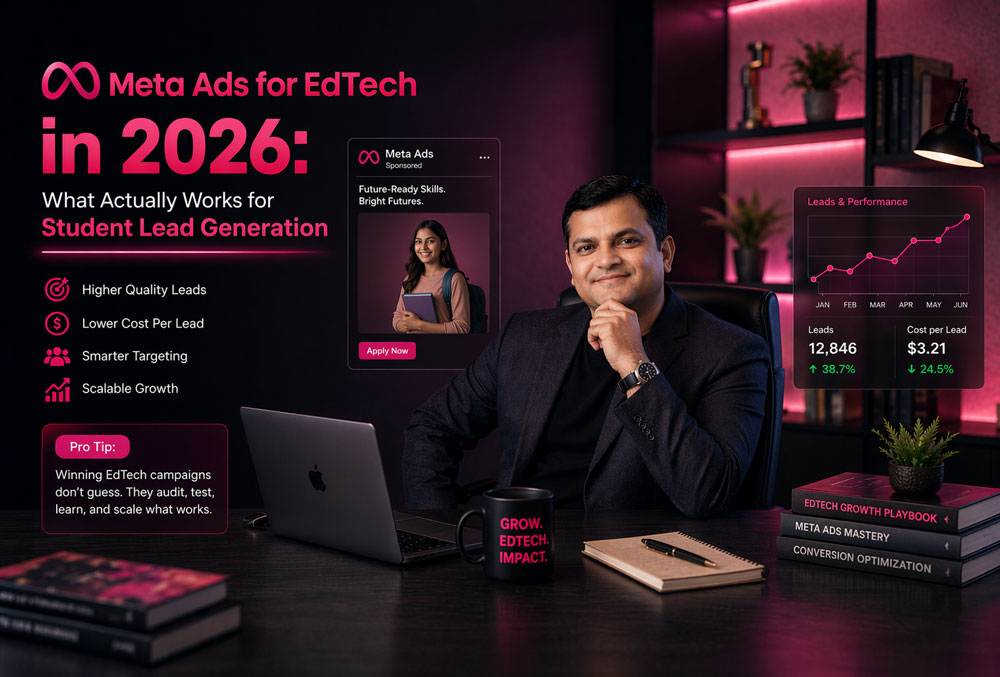
Meta Ads for EdTech still work in 2026, but the old playbook is completely broken. Cheap CPL is a trap. Today’s winning strategy relies on Content + lead capture + platform engagement + a conversion system that is sales-oriented driven. Success requires high-friction qualification, rapid speed-to-lead, and routing deep-funnel CRM data back to Meta via the Conversions API (CAPI) to train the algorithm on actual enrollments, not just vanity form fills.
The End of the Volume Game
Platform badal gaya hai. Purane hacks ab waste hain. If you are an EdTech founder or growth leader reading this in 2026, you already know the truth. The tricks that built massive cohort numbers in 2023—micro-targeting, clickbait creatives, and optimizing strictly for the highest volume of cheap leads—are now actively burning your runway.
I see this every single week. A mid-size EdTech brand comes to us saying, “Our agency is getting us leads for $3, but nobody is buying the $1,500 program.”
If you are still judging Meta by lead volume alone, you are optimizing the wrong system.
Meta’s scale remains massive. Platform data shows Family daily active people averaging 3.58 billion in late 2025, with ad impressions rising year over year. The opportunity is there, but the competition inside the auction has matured. The global education market is racing toward $10 trillion by 2030, according to HolonIQ, making buyer expectations sharper than ever.
In my 20+ years of industry experience, and as the Founder and CEO of UXGen Metalabs, I do not talk about “just getting cheaper clicks.” My focus is entirely on business impact and ROI. The question for your brand is no longer, “Can Meta generate leads?” It can.
The real question is this: Can your Meta system generate leads that actually show up, speak to counselors, begin applications, and convert into paid enrollments?
Why Meta Ads Got Harder (And Smarter) in 2026
EdTech is not selling a T-shirt. You are selling trust, aspiration, time, money, and future career movement. That makes the funnel longer, the objections heavier, and the quality problem much more dangerous.
Simultaneously, Meta keeps pushing advertisers toward more AI-assisted delivery. Meta’s Advantage+ products optimize campaigns in real-time, using AI to deliver ads to more relevant audiences across broader placements. They are systematically removing narrow manual targeting controls.
So yes, the platform is smarter. But that also creates a massive liability for lazy advertisers: If your offer, lead form, tracking, and follow-up are weak, Meta’s AI will scale your weakness faster than ever before. When you tell Meta to find “leads” without qualifying them, Advantage+ aggressively finds users who love filling out native forms but have zero purchasing power or intent. You end up subsidizing a database of window shoppers.
Meta is explicitly telling us what matters now. Advertisers using the conversion leads performance goal with CRM integration through the Conversions API (CAPI) saw an average 15% lower cost per quality lead and 44% more qualified leads. In fact, from April 2026 onward, new campaign creation using that goal isn’t even available without CAPI integration. That is a hard platform shift.
The 2026 EdTech Meta Model: What Actually Works
What works now is not one clever ad or a hidden targeting hack. It is a full-funnel student acquisition system. You have to trade the obsession with CPL for a relentless focus on unit economics.
| Strategy Component | The Old EdTech Playbook | The 2026 UXGen Metalabs Approach |
|---|---|---|
| Targeting | Narrow interests & behavior stacking | Broad + controlled Advantage+ AI delivery |
| Capture Mechanism | Native, low-friction Lead Forms | Qualification-first, high-friction capture |
| Primary KPI | Obsession with cheapest CPL | Cost per Qualified Lead & Cost per Enrollment |
| Landing Pages | One generic page for all traffic | Funnel pages mapped by intent and stage |
| Data Flow | Manual CSV exports to sales teams | Real-time CRM + Conversions API signal loop |
| Follow-up | Slow, manual counselor outreach | Speed-to-lead automation + WhatsApp integration |
| Creative Testing | One “hero” ad running for months | Multi-angle, rapid creative testing matrix |
The 4-Stage Conversion Architecture for High-Ticket Courses
For enterprise and mid-market EdTech brands, running one mixed campaign and hoping for the best is a recipe for leakage. You cannot ask a cold prospect to drop $2,000 on a certification course off a single ad click. We split the system into four deliberate stages:
1. Demand Creation (Pre-framing the Offer)
Use Reels, short videos, proof-led statics, and founder or mentor-led explanation ads to shape perception. Your goal here is to sell the problem, the outcome, and the category belief.
- Angle: “Why most students pick the wrong Data Science course.”
- Angle: “Why cheap bootcamps create false confidence in interviews.”
- Angle: “What hiring managers actually value after course completion.”
2. Lead Capture (Adding Intentional Friction)
Meta supports both instant forms and website forms. Use instant forms when mobile speed matters, but always use the “Higher Intent” setting. Stop asking just for a name and number.
Ask better questions to force qualification:
- What specific course are you interested in?
- When do you want to start? (Immediately, 1-3 months, Just researching)
- Are you a student, working professional, or parent?
- What is your budget comfort range?
Those questions do two jobs: they filter out low-intent clickers, and they arm your admission counselors with the exact context they need to close the deal.
3. Retargeting and Qualification
If they consume your content but don’t convert, do not let them go cold. Meta’s Custom Audiences let you build sophisticated retargeting layers. We build warm pools by retargeting:
- Video viewers (25%, 50%, 75% completion).
- Landing page visitors who bounced.
- Form openers who did not submit.
- WhatsApp clickers.
For India-first EdTech, click-to-WhatsApp can work incredibly well when paired with scripted qualification bots and CRM hygiene.
4. Enrollment Conversion (Fixing the Leaks)
This is where most EdTech brands fail. They generate the lead, then throw it into a weak, slow counselor workflow. That is not a media buying problem; that is operational leakage.
If your ad promises a career transition, but your landing page answers nothing important, and your team takes 24 hours to respond, you lose. Speed-to-lead is critical. Harvard Business Review research shows that conversion rates drop massively if you don’t respond within the first 5 minutes. In EdTech, where students are opening multiple tabs and inquiring with competitors simultaneously, speed is your ultimate advantage.
Creative That Qualifies Before the Click
The biggest creative mistake in EdTech is trying to make ads look “high performance” while saying absolutely nothing meaningful. Your creative is your targeting. It should not just attract attention; it must pre-qualify intent.
We structure creative testing around four specific psychological angles:
- The Outcome Angle: Show the real future state. Use portfolio outcomes, placement transition stories, and actual salary shift logic.
- The Decision Clarity Angle: Reduce confusion by explicitly stating who the course is for—and, more importantly, who should not join. “This AI cohort is NOT for beginners” is a fantastic hook that drives away bad leads and magnetically attracts qualified ones.
- The Proof Angle: Leverage raw trust assets. Use real student screenshots, live class clips, application walkthroughs, or a mentor-led teardown of the curriculum.
- The Cost-of-Delay Angle: Push urgency for higher-intent audiences. “Another quarter without the right skill stack” or “Why waiting for free YouTube learning usually costs more in lost salary.”
The Real EdTech Scorecard (Metrics that Matter)
If you are a founder, do not let your marketing team stop at CPL. It creates a false sense of security. Track this entire stack to understand your true unit economics:
The 2026 EdTech Funnel Map
The 2026 EdTech Funnel Map
(CTR / Hook Rate)
(The Old Vanity Metric)
(Show-up rate)
When you track this path, you often find that the ad set generating $15 leads is actually vastly outperforming the ad set generating $5 leads, because the $15 leads have a 4x higher enrollment conversion rate.
Why UXGen Metalabs Is the Best Partner for Solving This
At UXGen Metalabs, we should not be positioned as “just another Meta Ads agency.” We are specialists in Meta Campaign Audits and Performance Intelligence for brands that care about lead quality, conversion clarity, and scale.
Most agencies optimize surface metrics. They chase cheaper clicks. They celebrate vanity leads on Friday, leaving your sales team miserable on Monday. They rarely fix the system behind the campaign.
We work differently. Our real job is to diagnose the full revenue path. We look for audience and intent mismatch, weak creative angles, landing page friction, instant form leakage, broken CRM feedback loops, and poor optimization signals inside Meta.
A Realistic EdTech Case Pattern
Note: This is a representative, anonymized EdTech case model built from the kind of funnel problems this market commonly faces.
Client Context: A live-cohort EdTech brand focusing on tech upskilling was generating leads at an acceptable CPL, but counselor teams complained that lead quality was incredibly weak. Show-up rates for counseling sessions were below 15%. Enrollment efficiency was worse than the ad dashboard suggested, and their CAC was eating their margins.
The Approach: UXGen Metalabs audited the system and immediately stopped optimizing for volume. We rebuilt the account around:
- Clearer creative segmentation mapped by awareness stage.
- Higher-intent instant forms with mandatory budget and timeline drop-downs.
- Landing page message-match cleanup to ensure the promise in the ad was reflected on the page.
- CRM tagging for ‘Qualified’ vs. ‘Unqualified’ leads.
- The Master Lever: Implementing Conversions API (CAPI) feedback to send downstream lead quality data back to Meta.
Modeled Outcome: Initially, the CPL doubled. The client was nervous. But within three weeks, the system reduced wasted lead volume by 60%, drastically improving counselor call efficiency. Show-up rates jumped to 45%. Because we were feeding Meta clean data, the algorithm shifted budget toward ad sets that produced stronger downstream intent.
The core insight here is critical: When the signal improves, Meta’s automation becomes a massive asset. When the signal is noisy, automation becomes an expensive liability. That is the real reason UXGen Metalabs is valuable. Not just because we can launch ads, but because we can read the funnel as a cohesive business system.
Frequently Asked Questions (FAQ)
- Do Meta Ads still work for student lead generation in 2026?
Yes, but the winning setup has completely changed. Meta still has massive reach. What changed is that low-friction lead capture alone is no longer enough. Signal quality, CRM integration, downstream qualification, and follow-up speed matter much more now. Meta’s updates around Advantage+ and CAPI make this direction undeniable.
- Are instant forms better than website forms for EdTech?
Neither is universally better; it depends on the funnel stage. Instant forms are better when you need mobile-first conversion and lower friction at the top of the funnel. Website forms are better when you need deeper education, stronger qualification, or a more serious application journey. The right answer is usually using both, then comparing downstream quality, not just lead count.
- What is the best Meta campaign objective for EdTech leads?
For most mature EdTech brands, the best answer is the setup that lets Meta optimize toward better downstream outcomes. That means using CRM-linked conversion leads via the Conversions API. If your backend is not ready, start with lead ads carefully using higher-intent forms. If your backend is ready, teach Meta what a qualified enrollment actually looks like.
- How should EdTech brands target audiences on Meta now?
The old playbook of endlessly stacking interests is dead. Meta increasingly relies on AI-led audience finding, Advantage+ behaviors, and broader delivery controls. This means you need stronger offer clarity and creative segmentation. Audience strategy is now less about hacking interests and more about feeding the system a cleaner definition of success.
- How can EdTech brands improve lead quality from Meta Ads?
Start with the form and the feedback loop. Use higher-intent forms, add custom qualifying questions, verify phone numbers where relevant, sync leads to your CRM instantly, and pass back qualified lead outcomes through CAPI. If quality is still low, fix the landing page message-match and counselor workflow. Lead quality problems are rarely just a targeting issue.
- What metrics matter more than CPL for student enrollment campaigns?
CPL is only the first filter. The real metrics are cost per qualified lead, counselor connect rate, show-up rate, application start rate, cost per enrollment (CPE), and payback speed. EdTech is a revenue funnel. The brands that win track the whole path from impression to revenue, then send that reality back into the ad system.
- Is Conversions API (CAPI) now mandatory for serious EdTech advertisers on Meta?
If you want Meta to optimize toward stronger lead quality, it is very hard to ignore. Meta has stated that from April 2026, new campaign creation for the conversion leads performance goal requires CAPI integration. Serious advertisers must treat CAPI less as a technical add-on and more as critical measurement infrastructure.
- What kind of content helps this blog rank in Google and AI search?
The content that wins now is clear, specific, original, structured, and deeply useful. Google recommends unique, helpful, non-commodity content built for people first. The right move is not gaming AI search with gimmicks. It is creating strong answers, structured data (like our table and charts), unique analysis, and real executive expertise that decision-makers can trust.
Conclusion: The Shift to Conversion Intelligence
Meta Ads for EdTech still work in 2026. But the brands winning now are not the ones chasing the cheapest lead.
They are the ones building better qualification, cleaner tracking, sharper creative angles, faster follow-up systems, and optimizing toward revenue, not vanity metrics. That is the shift you must make.
If your current Meta setup is generating volume but not momentum—if your sales team is exhausted from calling dead leads—the issue is probably not just ad performance. It is funnel design, signal quality, and conversion intelligence. Stop buying clicks, and start engineering enrollments.
About the Author